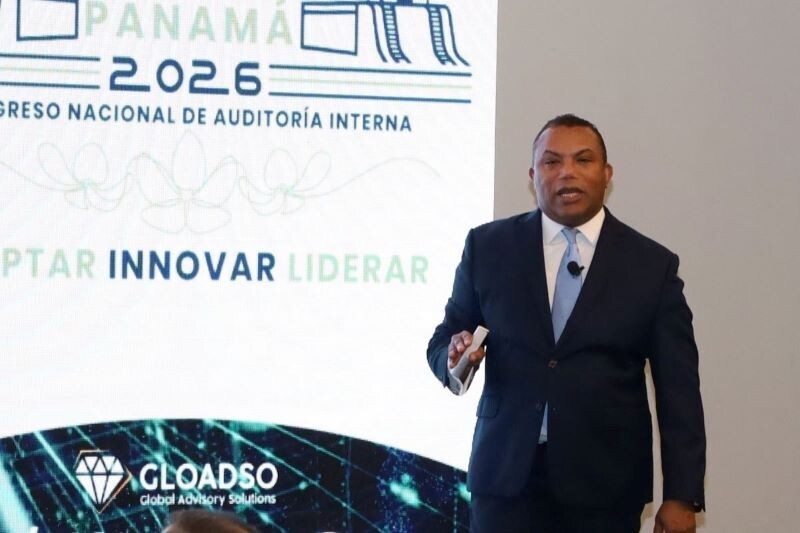
The future of Internal Audit in organizations and institutions must be geared towards the adoption of technology as a strategic tool to mitigate risks in the digital age. In his speech, the expert explained that Information and Communication Technologies (ICT), combined with the use of Artificial Intelligence (AI), offer unprecedented possibilities for managing threats in less time, although they require a profound cultural change in professional practice. According to Jolly Moore, it is a reality that current risks stem directly from technology, especially in fields like cybersecurity. Threats such as the loss of sensitive information and the growing attempts of cybercrime require that professionals in the field integrate innovative solutions to ensure corporate security. At the 2026 Congress of the Institute of Internal Auditors of Panama (CONAI), Julio Jolly Moore, Managing Partner of Global Advisory Solutions (GLOADSO), presented the conference “Risk-Based Dynamic Audit.” This need for technological evolution is based on the advancement of tools used by cybercriminals. Therefore, he urged auditors to identify and assess these threats in all phases of their processes, adapting with agility to the constant digitalization of work operations. These techniques allow for the imitation of voices and images of users for identity theft, bank fraud, and the evasion of facial recognition security controls. Against this backdrop, the CONAI 2026, organized by the Institute of Internal Auditors of Panama—a chapter of The Institute of Internal Auditors Global—reaffirmed its position as a professional authority in the country, promoting strategies that allow Internal Audit to be a pillar of resilience against the criminal use of synthetic elements and fraudulent applications on social networks. A global study conducted in 47 countries shows that 54% of citizens do not fully trust artificial intelligence, while 70% demand stricter regulations to curb disinformation and the misuse of personal data. Artificial intelligence has transformed efficiency and creativity in the digital realm; however, in 2026, the debate focuses on the ethical limits of its application. When this technology completely replaces human judgment, errors cease to be technical failures and are perceived by the audience as a profound lack of sensitivity and indifference to the social context. The resistance to this technology is not an isolated phenomenon. In an era dominated by the synthetic, the ability to interpret context and decide with human sensitivity has become the most extraordinary and necessary value for contemporary strategic communication. Julio Jolly Moore, Managing Partner of GLOADSO, raised the need for a cultural change in the profession towards a proactive attitude in the face of the threats of the digital age. A global study reveals that 54% of people distrust artificial intelligence, which forces companies to use active listening tools to protect their reputation. This technique works as a radar capable of identifying changes in tone, nascent ironies, and criticisms that could escalate into digital crises in a matter of hours. This tension places brands in a scenario where the margin for error is minimal, as the public reacts harshly to content perceived as cold or opportunistic. Teresa Velasco Basurto, Social Media Director of the agency another, argues that the problem arises when companies automate sensitive decisions. “AI does not cross the line by itself; brands cross it when they use it without context,” states the expert, pointing out that the use of bots to manage emotional conversations or to join trends without cultural understanding is interpreted as a lack of respect for the audience. In this context, social listening evolves from a simple metrics dashboard to an essential cultural reading tool. Detecting these small, unattended discomforts is key to preserving credibility and avoiding the deterioration of brand perception. The speed of artificial intelligence acts as an amplifier: if there is clarity and judgment, it amplifies the message; otherwise, it accelerates the spread of the error. According to specialized reports, the use of AI to generate audio and video scams through “deepfakes” represents an even greater challenge.