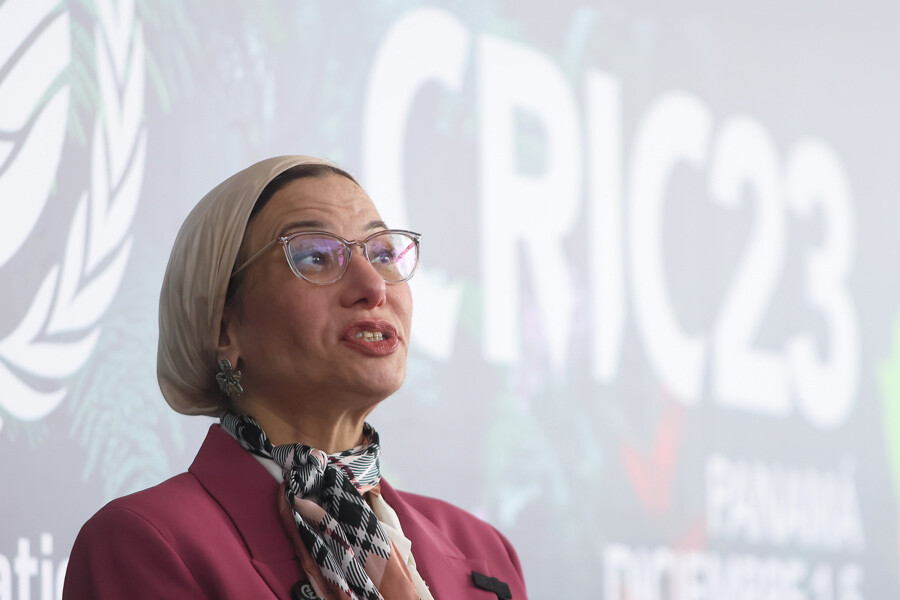
The Executive Secretary of the United Nations Convention to Combat Desertification (UNCCD), Yasmine Fouad, highlighted the urgency for the world to act decisively against this phenomenon, which degrades fertile lands and directly impacts the food security and social stability of the affected regions. Fouad, former Minister of Environment of Egypt, spoke with EFE within the framework of the 23rd session of the Committee for the Review of the Implementation of the Convention (CRIC23), which is the only legally binding framework established to address desertification and the effects of drought. 'We must ensure that the United Nations Convention to Combat Desertification, for its 196 member countries, will result in more than just words. This includes turning commitments into on-the-ground actions through the convention's global mechanism,' stated Fouad. CRIC23, which concludes this Friday in the Panamanian capital after five days, has focused on analyzing efforts to combat desertification, land degradation, and drought in the face of 'the urgency to act' against phenomena advancing at an alarming rate worldwide, the UN warns. The consequences are clearly seen in the price of food and social instability when considering this issue in Latin America, one of the regions that loses the most soil in the world, mainly due to agricultural expansion. 'We cannot expect food prices to be affordable if we continue to degrade the land,' warns Fouad, pointing to the 'direct consequences on the economy' of desertification, which the UN defines as the degradation of land in arid, semi-arid, and dry sub-humid areas resulting from various factors, such as climatic variations and human activities. In the case of Latin America and the Caribbean, the region has the world's most expensive healthy diet, costing more than five dollars a day, according to officials from the United Nations Food and Agriculture Organization (FAO) who spoke to EFE. There is also a 'clear link' between land degradation, drought, and migration, adds Fouad, referring to the Central American Dry Corridor, a strip that includes Costa Rica, Nicaragua, Honduras, El Salvador, and Guatemala and has a population of around 10.5 million people. 'The more degraded the land is, especially in arid regions, the more difficult it is for people to continue living in their places of origin and therefore they are forced to migrate,' she explains. 'We must integrate the health of the land into discussions on security, because one cannot talk about stability without talking about the health of the land,' Fouad asserts, stressing the urgency of investing in the restoration of degraded lands and protecting healthy ones. In this sense, she defended the importance of synergy among the climate change, biodiversity, and desertification conventions, pointing out that 'this coordination allows for the optimization of financial resources, the acceleration of action, and the reflection of the inherent interconnection of nature.' 'God made all the elements of nature as part of a single creation, so we must once again value this interconnection,' she emphasizes. She also acknowledges that at this time, in a context where 'multilateralism is being tested,' it is imperative to 'maintain trust between the parties'.