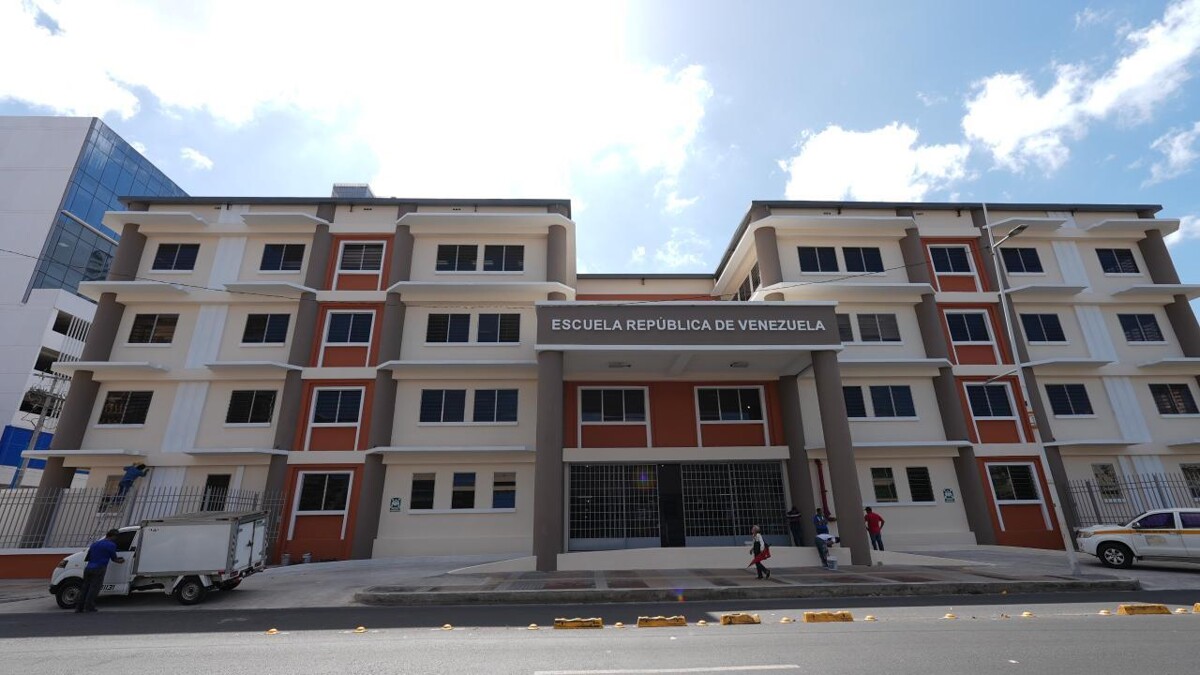
The old structure located in Calidonia was demolished to make way for a new building that houses the República de Venezuela School and the Bolívar Commercial Institute. The inauguration was presided over by President José Raúl Mulino, who, during the ribbon-cutting, addressed the students: 'You don't have to do anything but study.' Mulino highlighted that this institution represents both the historical memory of the country and the commitment to quality education. Now completed and operational, it is expected to train students with a better quality of teaching. On her part, the Minister of Education, Lucy Molinar, acknowledged that the project had delays. 'This has been a struggle, not only because it took a long time to build, but because I aspire for it to be the last school where contractors and Meduca are in a tug-of-war over quality,' she expressed. In the midst of the inauguration, Mulino referred to the need for a new organic law on education. He pointed out that the country must update its educational system to respond to current challenges, especially in a context marked by technology and artificial intelligence. He insisted that education must be more equitable and generate better opportunities for young people. Mulino made it clear that he is in no hurry to pass the law. 'Today it is evident that with effort and planning, works that remained abandoned for years can be completed,' he noted. The new 21 million dollar building will benefit more than 1,600 students, who will have 28 classrooms, modern laboratories, psycho-pedagogical offices, and fully accessible spaces. Its facilities include a dining hall, administrative area, kiosk, and a gymnasium on the third floor, which houses multi-use courts and separate locker rooms for girls and boys. 'For me, it is a great pleasure to inaugurate works, to see that schools, hospitals, roads, stadiums, penitentiary centers, Zarzo bridges are finalized for the community,' Mulino highlighted, recalling that this institution symbolizes the fight of the teacher guilds against the military dictatorship. In an effort to maintain the identity of the educational center founded in 1929, the historic facade was preserved with the technical advice of the Ministry of Culture. The safety of the educational community will be a priority in the new facilities, which include video surveillance systems, restricted access control, and a modern fire system. This project seeks to settle a historical debt with the education sector in a strategic point in the city of Panama. The work is part of a debt that the country's education system has dragged on for years. That is why he reiterated that the goal is to build a new norm with consensus, listening to students and different sectors, to reduce gaps and improve access to knowledge in the country. He also mentioned that working tables have already been held that have contributed ideas to the project. The president recalled that since the time of President Enrique Jiménez, the same organic education law has been in place, something he considers outdated. He explained that the important thing is that it is consulted and discussed with all sectors, allowing those who want to participate to do so, even during the debate in the National Assembly. What was the bastion of the struggles of teachers and professors today has a new face. 'It is not just a symbolic legacy, but access to quality education for thousands of Panamanians.'