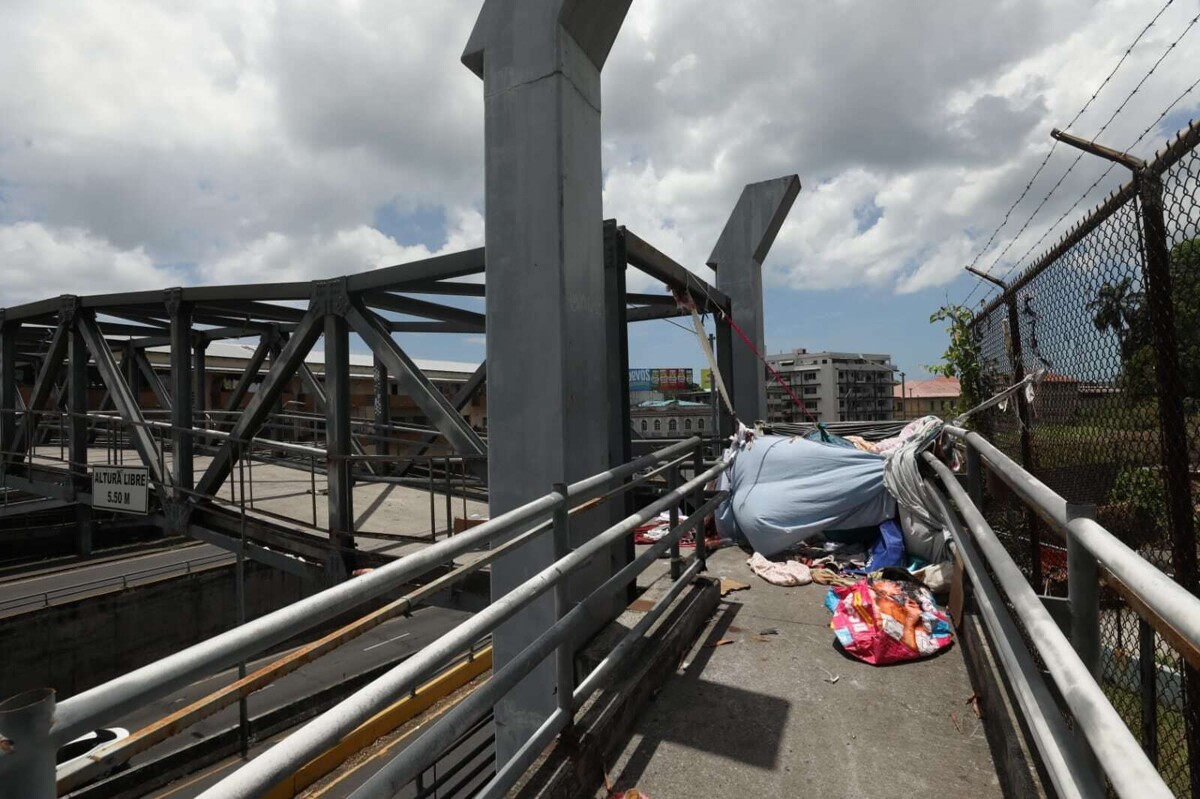
The growing presence of people experiencing homelessness, visible even in areas like Ancón, evidences a problem that is advancing without a sustained state response. A person is considered homeless if they live or habitually sleep in public spaces or places that are not a dwelling, according to Panama City Municipality Agreement 14 of January 16, 2014. This issue has been addressed at various governmental levels; however, the initiatives launched have not consolidated into sustained policies. During her address at the Municipal Council last Tuesday, the representative of Ancón, Yamireth Batista, exposed how her district is facing a new reality: the Metropolitan Camino de Cruces National Parks are gradually being inhabited by people experiencing homelessness. Batista also noted that the presence of these individuals is reflected even on the premises of Mercapánama, where makeshift shelters are beginning to be observed. Sleeping in parks, taking refuge in protected areas, or improvising roofs in public spaces has become an increasingly common scene in Panama City. She added that this is not an issue exclusive to the local government or the Mayor's Office, but one that should be addressed by the central government. In conversation with La Prensa, the head of Social Work for the Ancón Community Board, Katherine Ojo Díaz, stated that these working groups emerged after a tour of the district, which revealed an increase in people for whom the street has become their home. She explained that the objective was to coordinate actions with various entities, including the Ministry of Social Development (MIDES), as they identified that the country lacks programs, departments, or institutions dedicated to assisting this population at social risk. She added that despite repeated requests to the Presidency and the Mayor's Office, they have not received concrete responses. La Prensa attempted to contact personnel from the Municipality of Panama; however, no response was received. Back in 2020, the Mayor's Office estimated that there were about 250 people in this situation in the district of Panama. According to Ariel López, director of the San Juan Pablo II center—a home that for over eight years has offered prevention and comprehensive care programs for people with various addictions and vulnerable groups—there are currently between 550 and 600 people experiencing homelessness in the district of Panama. Meanwhile, at the end of 2025, the Mayor's Office estimated this population to be around 900 people in the district. The national census of population conducted by the National Institute of Statistics and Census (Inec) in 2020 counted 400 people in this situation. It is worth noting that more than a fixed figure, the number of people experiencing homelessness is in constant variation. This reality is marked by a daily duality: the emergence of new vulnerabilities that increase the statistic, versus cases of overcoming that achieve reintegration into an autonomous life. While the situation worsens on the streets, two bills aimed at addressing this phenomenon are pending in the Assembly National's Commission on Labor, Health, and Social Development, with no concrete progress to date. These are Bill 17, presented by independent deputy Manuel Cheng Peñalba in July 2024, and Bill 363, promoted by deputy Ernesto Cedeño from the Otro Camino Movement in July 2025. Both initiatives propose the creation of rehabilitation mechanisms for people with addictions, as well as the implementation of a governmental center in charge of executing these programs. In both cases, social reintegration and comprehensive care for this population are proposed. However, although they share similar objectives, one of the initiatives has been waiting for its first debate for almost two years, while the other will mark its first anniversary in three months without having been considered. Just a few meters from the Legislative Palace, the presence of people experiencing homelessness is part of the daily dynamic for passersby, drivers, tourists, and merchants. Batista indicated that although progress was registered at the time, the initiative did not continue, for which reason she requested its reactivation. “We have been asking for a root solution for more than a year and a half,” she emphasized.