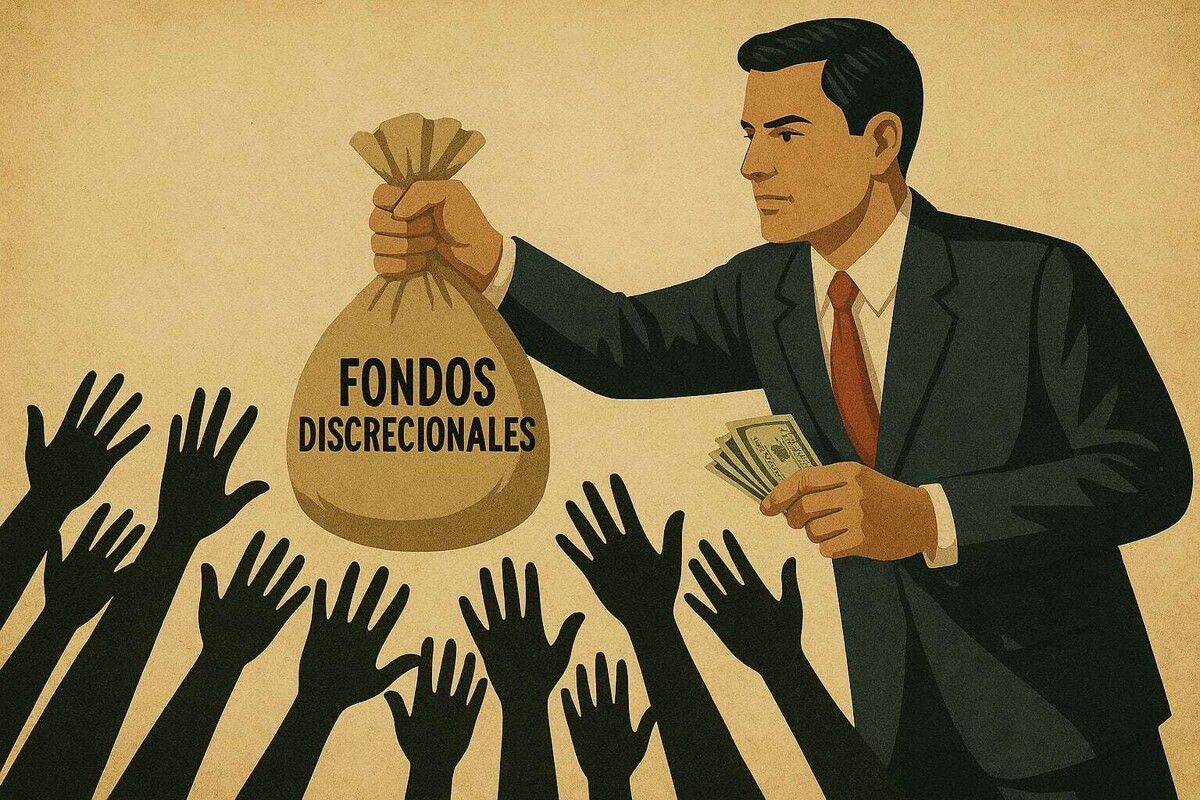
Discretionary spending, which the executive branch uses at its own discretion, is once again back on the public agenda. The deputy for district 8-2 (San Miguelito), Luis Duke Walker of Vamos, has introduced a bill to prohibit these allocations in the public sector. The bill draft, which is pending in the Committee on Economy and Finance, consists of only eight articles, but one of them, article 3, is unequivocal: “The allocation in the State budget of budgetary items whose use is discretionary by public officials is prohibited.” However, it warns that the country has witnessed numerous scandals related to excessive and unjustified expenses, resulting from legal loopholes that allow such practices. The deputy documents a pattern that repeats itself in all presidential periods. The law will define the minimum mandatory fields that must be published. Between 1994 and 1999, during the government of Ernesto Pérez Balladares of the Democratic Revolutionary Party (PRD), the administration that formalized these funds, $25 million was allocated. Notably, at least $200,000 was for carnival. It proposes that the prohibition cover budgets allocated for the execution by the President of the Republic and the Vice President; ministers and vice ministers; directors and deputy directors of autonomous and semi-autonomous entities; administrators and deputy administrators of autonomous or semi-autonomous entities; general secretaries of the ministries or autonomous and semi-autonomous entities; national executive secretaries of the Presidency of the Republic; managers and deputy managers of state enterprises; directors and deputy directors of ministries and autonomous, semi-autonomous entities, state enterprises, or any other public entity of the central government or local authorities. For transparency Article 5 states that all public entities must publish on their institutional portals detailed information on the execution of public funds, including transfers of budget items, additional credits, social aid, subsidies, scholarships, transfers, and any other benefit granted or received with public funds. To date, no government entity complies with this provision. Spending from president to president In the explanatory statement of the bill, Duke Walker explains that transparency and the responsible use of public funds must be a cornerstone of state administration. In that government, medical expenses for surgeries for minors and adults in Panama and abroad were also funded. You may also be interested: Presidency uses discretionary funds to pay for surgery for the head of the Security Council. In the administration of Laurentino Cortizo of the PRD, the treasury allocated $31.2 million. An investigation by La Prensa revealed that the Ministry of the Presidency disbursed at least $711,000 to pay for bariatric surgeries for 46 people, performed in private hospitals in the country: 33 at Punta Pacífica, 8 at Panamá Clinic, 3 at San Fernando, 1 at Paitilla, and 1 at the National Hospital. As of February of this year, the government of José Raúl Mulino of Realizing Goals had spent $2.5 million. Although a significant part was allocated for medical aid abroad, especially for minors with heart diseases, the report also records expenses such as the purchase of medical equipment from a private company, repair of presidential vehicles to attend to VIP visitors, a donation of $20,000 to the Diocese of Chitré for the cause of beatification of the Girl Anita, and $40,000 to a foundation for the sterilization of dogs and cats in Coclé. The initiative of the San Miguelito deputy pursues three objectives: to prohibit the allocation of these items, to strengthen transparency in public spending, and to ensure that resources destined for emergencies are channeled directly to the competent institutions, with corresponding controls. In total, since the discretionary item was formalized in 1994 until February 2026, the different governments have allocated at least $201.4 million in expenses without proper oversight, a figure that Deputy Duke Walker uses as a central argument to justify the need to eliminate these resources from the General State Budget. Thousands of dollars were also allocated for travel and protocols. Between 2009 and 2014, during Ricardo Martinelli's administration, then of the Democratic Change party, the petty cash of the Palace of the Herons registered its highest historical increase: $55.7 million. Bariatric surgeries and political donations disguised as social aid stood out, among other expenses with public money. Between 2014 and 2019, under the government of Juan Carlos Varela of the Panameñista Party, $41.7 million was used. At least $17,000 was spent on a bariatric surgery for the former head of the National Security Council. “No authority or public official may allocate public funds to aids, subsidies, or individual or collective benefits when these are not supported by institutional programs previously established in the State budget,” the document reads. Article 4 contains the scope of the measure. Another $38,000 went to the “unforeseen expenses to cover the cost of the credit card.” From 1999 to 2004, during Mireya Moscoso's government of the Panameñista Party, the discretionary item reached $23 million. Duke highlighted in the explanatory statement a fact that caused a scandal at the time: more than $588,000 in jewelry and nearly $942,000 in luxury clothing stores. Read here: The old trick of the gift. In the administration from 2004 to 2009, government of Martín Torrijos, then leader of the PRD, spending on the discretionary item reached $22.3 million. A large part of the money was destined for “professional services and advice,” without detailing what those services were. As revealed at the time by La Prensa, the document accounted for purchases in jewelry stores for “attention of the Higher Office,” without specifying what was bought, for what, or for whom.