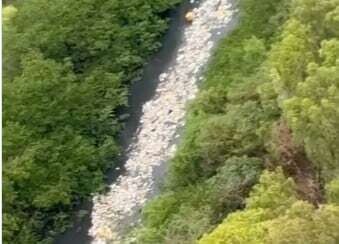
The Minister of the Environment, Juan Carlos Navarro, spoke about the critical situation of the Matías Hernández River, which he described as a "dump" due to the accumulation of solid waste evidenced after the first rains of the year 2026. The situation was widely spread yesterday on social networks, where users shared images of the river with a large amount of trash carried by the water, after the rains recorded in the morning. Navarro pointed out that the deterioration of the river is due to citizen irresponsibility and deficiencies in waste management, factors that have allowed waste to accumulate in its course. "The Matías Hernández River has become a dump due to the irresponsibility of citizens and the lack of response," expressed the minister, emphasizing that rivers do not contaminate on their own. In this sense, he stressed that the garbage observed comes directly from the streets and homes, so it is a problem that involves all of society. "This is a problem that involves us all." In 2019, the environmental organization Marea Verde installed the BoB system in this tributary. That same year, the collection of more than 70 tons of waste was reported, equivalent to more than 10,000 bags, which included plastics, tires, and bulky objects such as refrigerators and industrial tubes. In fact, the environmental organization plans to install the BoB system again in this river as part of "Seven Basins", a project that aims to reduce plastic pollution from its source, intervening in the main urban rivers that flow into the bay of Panama. The "Seven Basins" project was born from the organization's experience in the Juan Díaz River, where since 2022, more than 477,000 kilograms of floating waste have been intercepted, preventing them from reaching the sea thanks to the joint work of the Wanda Díaz hydraulic wheel and the floating barrier BoB. The head of the Environment portfolio recalled that Panama has an extraordinary natural wealth, whose conservation is a shared duty between authorities and citizens. "For our rivers, for our basins, for our communities, and for the country we want to leave to future generations, let's do the right thing," concluded Navarro. The call, from both authorities and environmental organizations, points to the urgent need to strengthen environmental education, improve waste management, and foster greater citizen responsibility. "It is urgent that rulers and citizens change their habits, assume responsibility, and understand that every action counts," he added. The head of the Environment portfolio called for not throwing waste in public spaces, for properly disposing of garbage, and for protecting natural environments. Background and cleanup efforts in the river The problem with the Matías Hernández River is not new. The situation of the Matías Hernández River shows that the protection of natural resources does not depend on isolated actions, but on a constant commitment between the State and the population. (Barrier or Trash), a floating structure designed to intercept solid waste before it reached the mangroves and the sea, becoming one of the first visible solutions against plastic pollution in the country's urban rivers. During its implementation, especially during intense rainy seasons, the system managed to retain large volumes of garbage, preventing its displacement to coastal areas.