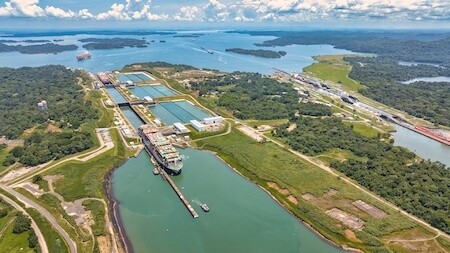
On Saturday, Panama showcased its role as a regional logistics platform in Asunción following the signing of the Association Agreement between Mercosur and the European Union. This agreement integrates over 700 million consumers across two continents and establishes a new framework for exchange between South America and Europe. During the event, the President of the Republic, José Raúl Mulino, stated that the country's geographical position and logistics infrastructure can contribute to the implementation of the agreement by facilitating the commercial flow between the two blocs. Panama highlighted its role as a regional air connectivity hub, with 576 weekly frequencies between the country and Mercosur member and associate states to 42 cities, with efficient links to the Caribbean, Central America, North America, and Europe. In the logistics sphere, the Panama Canal and the national port system were mentioned as key assets. According to figures presented at the meeting, the country closed 2025 with a movement of 9.9 million containers and has two of the four largest ports in Latin America. The context of the agreement was also linked to Panama's recent removal from international discriminatory lists, a process that has allowed it to expand its participation in integration schemes and economic cooperation with other blocs. Mulino also indicated that the country is advancing an initial proposal for the negotiation of a trade agreement with Brazil, whose terms of reference could be signed during the CAF Forum scheduled for January 28 in Panama City. The signing of the Mercosur–European Union Association Agreement took place at the José Asunción Flores Grand Theater of the Central Bank of Paraguay and brought together the heads of state of the Mercosur member countries, authorities of the European Union, and Panama as an Associated State of the bloc.