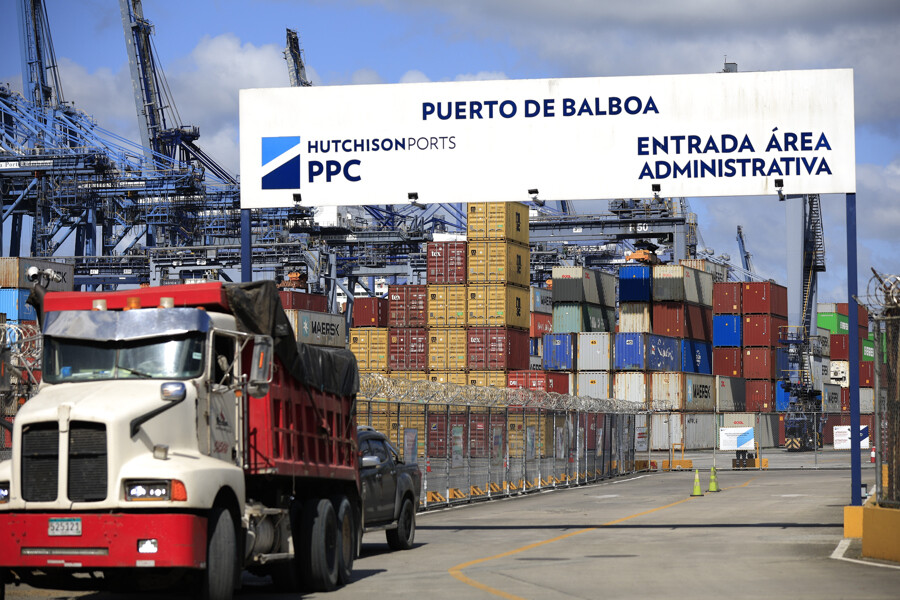
The Panamanian state will define a new exploitation model for the ports currently managed by Panama Ports Company (PPC) during the transition period. The objective is to break the monopoly scheme by separating port operators, a measure aimed at introducing greater competition in the sector and generating an economic dynamic more in line with the ruling of the Supreme Court of Justice and the National Constitution.
The above was pointed out by lawyer and port expert Ariel Corbetti, who explained that the redefinition of the port model implies that the ports will no longer be under a single operator but will be divided among different companies, thus modifying the structure under which one of the country's strategic economic sectors has been exploited.
Corbetti indicated that the breaking of the monopoly would have as a direct consequence greater competition within the sector, which will impact the way port operations and the linked economic dynamics are developed.
In his opinion, this new scenario better adjusts both to the ruling issued by the Supreme Court and to the principles established by the National Constitution.
The lawyer stated that during the transition period, the definition of the port exploitation scheme currently in the hands of PPC will be key, as from that model will depend whether a real separation of operators is achieved and not just a formal change in administration.
Furthermore, Corbetti warned that to this process is added the eventual construction of two other ports, which will expand the sector's activity and pose new challenges for the Panamanian state in terms of organization and supervision.
In this context, the expert proposed the need to strengthen the Panama Maritime Authority (AMP) as the governing body of the port system, so that it can assume with greater capacity the control and orientation of a sector that will have more actors and greater operational complexity.
Similarly, he considered that a restructuring of the National Public Services Authority (ASEP) may be necessary, in order to monitor free competition among the logistics and transport operators that are part of the port chain.
For Corbetti, the presidential announcement not only modifies who operates the ports, but also how the State must supervise and order the port market, so that competition is real and remains within the parameters required by the Constitution.
Corbetti's proposal comes after the Supreme Court of Justice declared unconstitutional the concession contract that allowed Panama Ports Company to operate the ports of Balboa and Cristóbal, located at both ends of the Panama Canal, considered key pieces of the national logistics hub.
Following the ruling, President José Raúl Mulino announced a transition period during which the Panamanian State will maintain administrative control while a new port exploitation scheme is defined, guaranteeing the continuity of operations and the stability of the shipping market.
Mulino also anticipated that the new model will not allow a single company to control both ports simultaneously, in order to avoid concentrations and promote a more competitive system within the country's maritime and logistics sector.
The ports of Balboa and Cristóbal are nerve centers of Panamanian international trade, connecting the transit of goods between the Pacific and the Atlantic, and their operation directly impacts shipping companies, carriers, logistics agents, and the economic movement that revolves around the Canal.
In this framework, the port transition becomes one of the most sensitive processes of the current administration, due to its economic, legal, and strategic weight for Panama's position as a regional logistics center.
On the other hand, Carlos Ernesto González de la Lastra explained that port operations should not be affected by the announced changes, since the cargo handled by these ports is mainly transshipment, i.e., merchandise that arrives in Panama to then continue on another maritime line to different destinations.
He indicated that this characteristic allows maintaining the fluidity of the system even in scenarios of administrative transition.
González de la Lastra added that the operator that eventually manages the ports would be a company with extensive experience in the sector, which represents an additional advantage, especially because it also administers the railway.
In his opinion, that combination of port and railway allows projecting a more efficient port service, by better integrating land and maritime logistics.
Regarding the legal plane, the analyst considered it was predictable that Panama Ports Company would request an international arbitration, but he emphasized that what is truly important is to guarantee the continuity of port operations.
In this sense, he pointed out that Panama must have all the necessary information that demonstrates that the decision to cancel the contract for unconstitutionality is duly justified, especially if there are elements related to contractual breaches.