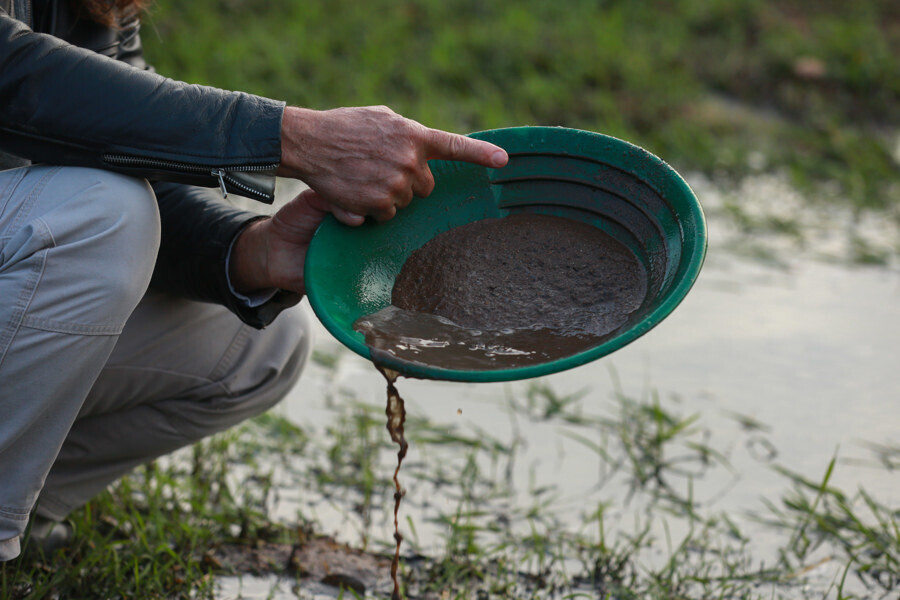
Is gold mining polluting? «And they would close the exploitation,» states the engineer. The engineer defends that, «like any industrial activity», gold mining is subject to strict regulations on pollution that have nothing to do with what he knew when he finished his degree in 1979 «when black muds were dumped into the river». «Things are done better now, first because the technicians want to. And second, because the legislation marks it. What sense would it make to do it badly so that a problem would land us in jail?» But the mercury that remains in the water and sediments reaches the trees or is ingested by animals, especially fish, and thus enters the human food chain. «I have seen with my own eyes in Nicaragua miners panning in the river, like the cowboys of yesteryear, with a little bottle of mercury tied to their belt. This is super-polluting,» describes mining engineer Alberto Lavandeira, CEO of Atalaya Mining, owner of Riotinto. Lavandeira, with over 40 years of international experience, assures EFE that 95% of gold comes from modern industrial operations, where mercury is never used. But a compound is used whose name is associated with dangerous practices: cyanide. «Most of the pure gold is mined from rock,» explains the engineer. It would be expensive, because if we were to dump it, we would be throwing away what we get, the gold. But all mines use cyanide in a closed circuit, there are no discharges. The controversy is over cyanide. «It is crushed and ground using a reagent that dissolves it, which is sodium cyanide, and once dissolved it is fixed on activated carbon and recovered. There can always be someone who does it wrong, but in general, no,» he affirms. Toxic trace However, it remains a challenge «to put an end to the toxic trail of small-scale gold mining,» according to PlanetGOLD, a program financed by the Global Environment Facility. According to its data, artisanal mining emits more than 2,000 tons of mercury per year, a metal that does not degrade. «This includes emissions to the atmosphere from heating amalgams, as well as direct losses of mercury to land and water,» it states. The environmental and health effects of mercury contamination «are not immediately visible and can vary depending on multiple factors». The program points out that there are practices that reduce or eliminate the use of mercury, including improved crushing and milling techniques and gravity concentration tools. But the main difficulty, it points out, is the lack of awareness of the dangers on the part of artisanal miners, and that is where many of their actions are focused. Small mining entities that join the program are required to have an environmental license to work in the area, a plan to reduce land and water degradation, and measures to protect surrounding ecosystems, among other requirements. Since the time of the pharaohs Alberto Lavandeira was surprised by the sharp rise in the price of gold in January, although he understands it as being «another currency» to which recourse is had in times of instability. And he highlights two aspects: gold production cannot be increased — «if it doesn't produce more it's because there isn't any: building a mine would take 3 or 4 years»- and it is a currency that is never destroyed. «All the gold that has been mined historically, since the time of the pharaohs, is still in circulation somewhere,» he assures. Photo EFE. The entry Gold: expensive, in-demand and polluting? was first published in La Verdad Panamá. Environment Section, Feb 6 (EFE).- Gold, which in January hit all-time highs in price and has since been through successive plunges and recoveries, is a metal of growing demand whose industry defends having rid itself of the problem of pollution, but whose extraction continues to present great risks, both to human health and to the environment, in artisanal mining. The use of mercury in small-scale mining, especially in South America and parts of Asia and Africa, has harmful consequences for the health of up to 100 million people, according to the PlanetGOLD project of the United Nations Environment Programme (UNEP). This sector, in the hands of artisanal miners or small-scale operations, sometimes illegal, is «the largest source of mercury pollution in the world». For 3,000 years, droplets of this metal have been used to amalgamate gold particles and thus facilitate its extraction.