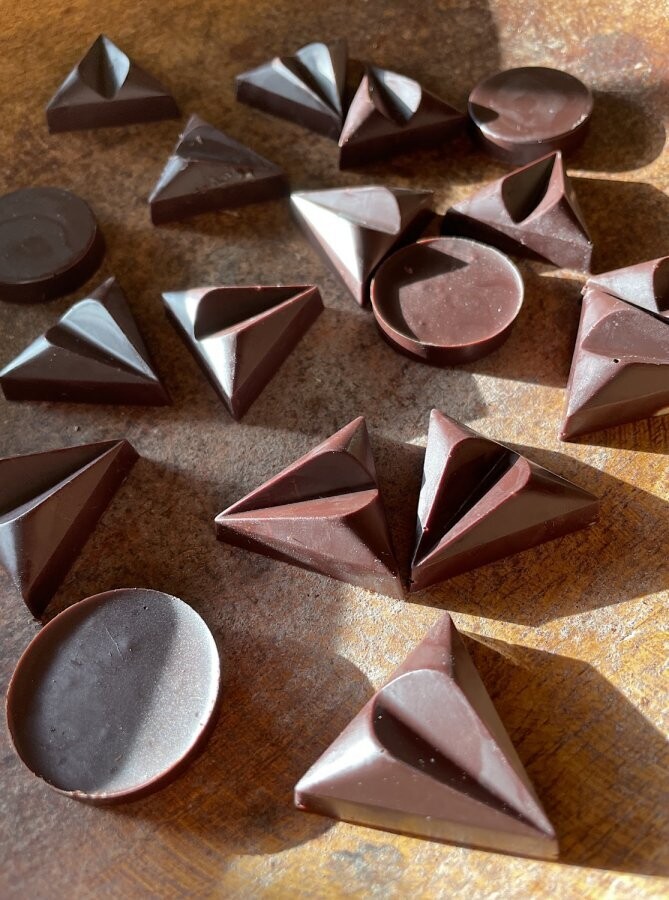
Over the past several years, chocolate itself has quietly changed, even while the name has stayed the same. As cacao prices have risen and global supply has tightened, many large manufacturers have adjusted their recipes to maintain production and cut costs. Food scientists and chocolate formulators have been tracking this shift for years. When cacao and sweetness are in harmony, the flavor has the depth and nuance that make chocolate taste like chocolate. This is the kind of chocolate I craft from the cacao I grow here. The complexity is already there. Real chocolate isn’t about intensity or bitterness. It’s designed to help you slow down, notice what’s actually in front of you, and understand what your palate is responding to. You don’t need Quetzal Cacao chocolate to use it. It carries flavor, creates texture, and allows chocolate to melt slowly on the palate. I loved how a little went a long way, how a small piece was enough, and how it melted slowly and stayed with you after the last bite. When I listen to people talk about chocolate now, many say the same thing: it doesn’t taste the way it used to. If you remember chocolate from before 2000, you probably know what they mean. Walk down the chocolate aisle at almost any supermarket and you’ll see endless options, all promising indulgence. But something has changed. You reach for something that should feel comforting, and it doesn’t satisfy in the way you expect. In some cases, products no longer contain enough cacao to be legally labeled chocolate at all. The cacao that results is usually selected for consistency rather than expression. This is the cacao most often used in mass-market chocolate, where flavor is adjusted later through formulation. You knew it by how it tasted, how it melted in your mouth, and how it lingered after the last bite. Today, chocolate is smoother, sweeter, and more available than ever. What’s missing is the substance that lets chocolate feel satisfying in a small amount. A small amount that feels like enough. That memory lives in the body as much as in the mind. When cacao content drops and sugar rises, the flavor hits sweeter and the cacao notes fade sooner. The result may look like chocolate, but it melts faster, feels greasier on the tongue, and the flavor fades more quickly. What Is Now Being Sold as Chocolate. Rich Hartel, a professor of food science at the University of Wisconsin–Madison who studies chocolate formulation, has noted that one of the most common changes is the reduced use of cocoa butter, the most expensive component of chocolate. Cocoa butter is the natural fat found in cacao. The language is subtle, but the difference matters. On a cacao farm, flavor begins long before chocolate is made, but how that flavor develops depends on how cacao is handled after harvest. In large commodity systems, cacao is often fermented in heaps or piles. Temperature, airflow, and timing are less precise, which makes flavor development less predictable. At scale, it becomes harder to monitor conditions closely. Cacao follows a similar divide. Fine-flavor cacao is handled more like specialty coffee. Fermentation is monitored closely, typically lasting seven to eight days, followed by six to seven days of drying. Beans may be roasted more aggressively to create a single dominant note, which is why many dark chocolates on supermarket shelves taste uniformly bitter rather than layered or nuanced. In Panama, most people already understand this distinction through coffee. Specialty coffee is handled with attention to origin, fermentation, and roast, while commodity coffee is processed for volume and consistency. The kind that doesn’t need much to satisfy. The kind that brings people back to how chocolate once felt. If you’d like to explore this for yourself, I’ve created a simple tasting guide called How to Taste Chocolate Like a Pro. You can start with the best chocolate you can find where you live. When choosing a bar, turn it over and read the ingredients. Look for just a few real ones: cacao, sugar, and cocoa butter. If there’s much more than that, especially emulsifiers or added flavorings, you’re tasting formulation rather than cacao. This is an invitation to come home to real chocolate, not through comparison or critique, but through experience. Download the guide here: How to Taste Chocolate Like a Pro. Some things don’t need to be sweeter to be better. They just need to be remembered. Lyn