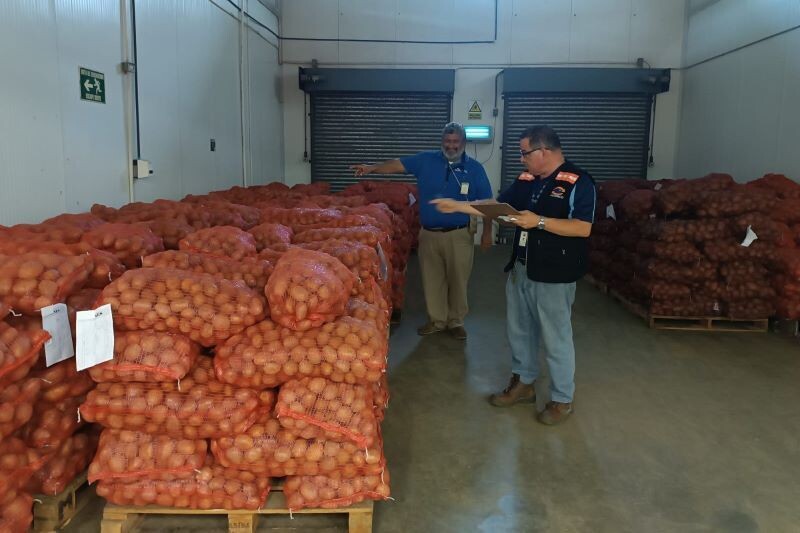
In a joint action aimed at protecting consumers and national producers, the Ministry of Health (MINSA) and the Authority for the Protection of the Consumer and Defense of Competition (ACODECO) conducted an inspection operation to verify the commercialization of onions in the province of Herrera.
Authorities detected various anomalies in supermarkets, distributors, and local businesses that were in violation of current regulations.
Violation of the technical regulation The verifications were carried out under the framework of the technical regulation DGNTI-COPANIT 52-2017. Among the most frequent reported violations was the sale of imported onions deceptively labeled as a national product, the presence of vegetables in poor condition, deficiencies in packaging, and the absence of mandatory expiration dates.
According to technical regulations, all packaging and labeling must clearly inform the category, the caliber, the packaging date, and the harvest date. Likewise, the regulation stipulates that for its commercialization, both local and foreign products must be kept at a temperature of between 0° and 4° degrees, with a maximum storage period of 120 days from its harvest.
Consumer protection and sanctions Ramón Abadi Balid, administrator of ACODECO, stated that these measures seek to eradicate practices that harm the Panamanian producer and attack public health, especially when offering a product that has exceeded its shelf life.
The entity emphasized that it will continue with these operations to ensure that the imported onion is free of pests and contaminants.
In accordance with Law 45 of 2007, economic agents that incur in these infractions are exposed to economic sanctions that can reach up to B/. 50,000.00.