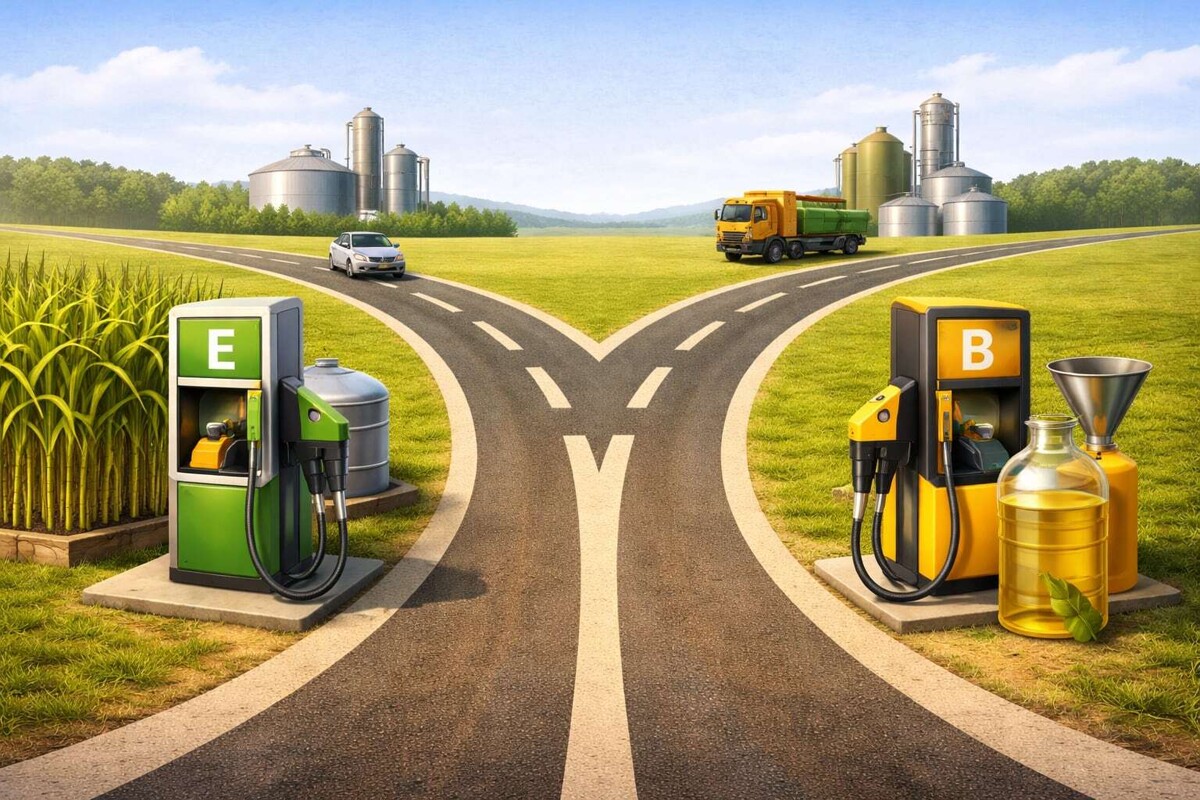
It is important to highlight that the ethanol used in E10 must be anhydrous, which not only implies an additional cost to eliminate that 5% of water present in its initial production, but also makes it more susceptible to problems associated with the presence of water in fuel tanks. Let's now look at the reasons behind the question of this article. To produce biodiesel, you don't need thousands of hectares of land, as is the case with sugarcane cultivation, which contributes little to the reforestation that a small country like ours so desperately needs. The reader might think that the production of biodiesel, due to involving chemical reactions, is very complicated; however, it is not. I refrain from presenting concrete values because they depend on the techniques and methodologies used; however, the aforementioned comparisons are widely recognized. I understand that the production of biodiesel is more expensive than that of ethanol, but the former can be mixed in much higher proportions than the alcohol, which implies an increase in the benefits associated with the use of biofuels. I invite restaurant chains and companies that use large amounts of vegetable oil to evaluate the production of biodiesel, not necessarily as a commercial activity, but as a show of commitment to energy independence and the environment. We must ensure that our efforts do not end up generating benefits for other countries to sustain dynamics that contribute little to our development, and even less to finance foreign conflicts. The author is a chemistry professor at the University of Panama. This glycerin byproduct can be purified for use in industrial applications or used in its crude state as a fertilizer in acidic soils, among other alternatives. In reality, there should be no incompatibility in the use of both systems, as they are not competitive: one is used for gasoline and the other for diesel. Producing ethanol also requires the use of fossil fuels, from the machinery for planting sugarcane to the final transport of the alcohol. Additionally, any company that generates used vegetable oil could produce biodiesel for its own consumption in vehicles. All this because ethanol did not lower gasoline prices and, due to its lower energy value, forced the user to 'dig into their pockets.' Let's clarify something: using gasoline with 10% ethanol (E10) does not mean we will save 10% of fossil fuel, because the ethanol will not fall from the sky. If we add to this the relatively low energy value of ethanol, the savings in fossil fuel would be around 5%, which, I admit, is not insignificant if we consider the millions of dollars involved. Furthermore, its production requires less fossil fuel than that of ethanol. Biodiesel, used, for example, in a 20% proportion (B20), is energetically superior to 100% pure diesel. I perfectly understand that the recent high fuel prices have awakened interest again in developing in Panama alternatives to fossil fuel. Proof of this is that there are small-scale plants that allow its production even in domestic environments, similar to how craft beers are made. Perhaps this does not happen for reasons similar to those that limit the use of solar panels: there is no immediate economic incentive that generates large profits for a few. The question of this article also arises because in Panama there are companies that collect used cooking oil from various businesses to later export it. The main challenge of biodiesel lies in the management of the alkaline glycerin that is generated as a byproduct. What I don't understand is why resort to ethanol, not because it is bad, but because in the recent past it was used and then abruptly rejected. Why allow other countries to benefit from that resource?