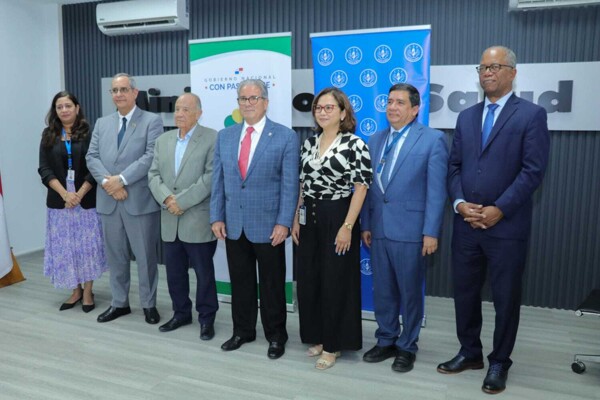
The director of the National Aqueducts and Sewers Institute (IDAAN), Rutilio Villarreal, reported on the progress of works to clean drinking water in the Azuero region, affected by the contamination of the La Villa river. He stated that as each sector is cleaned, water will be cleared for human consumption. The first to be declared safe for drinking will be the Llano de Piedra plant in Macaracas, followed by the Rufina Alfaro plant, the Roberto Reyna plant, and finally, the main plant in Macaracas.
Villarreal noted that for 45 consecutive days, the river has shown a decrease in its organic load, which allows for adjusting the chemical doses at the treatment plants. He also emphasized that the Minister of the Environment, Juan Carlos Navarro, has been firm and emphatic in the sanctions imposed on those who contributed to the high levels of organic matter in the river.
Villarreal clarified that the IDAAN had to hire companies to carry out the upgrades at the four affected plants: Macaracas, Rufina Alfaro, Llano de Piedra, and Roberto Reyna (the latter in Chitré). He added that modifications have been made to the water treatment processes.
Regarding sanctions for polluting the La Villa river, the IDAAN director explained that the institute is only a user and does not manage the hydrographic basin of that tributary. He estimated that the four affected regions covering the plants could be cleaned by February 7, but this does not mean people have to wait for that specific date.
Additionally, the IDAAN had to upgrade its laboratories and install control valves, cleaning valves, and fire hydrants that did not previously exist in the networks of Chitré, Las Tablas, Guararé, Llano de Piedra, and Macaracas. Since November 6, the IDAAN has begun the disinfection work at one of the four affected plants.
Villarreal highlighted that the most complicated part of the disinfection task has been the large number of tests that IDAAN experts had to conduct to adjust the dosages of chemicals used for water purification. "We had to bring in international experts who helped us obtain these new parameters for water treatment," he said.
According to Villarreal, the IDAAN has invested around 11 million dollars in the disinfection of the four potabilizers in the Azuero region affected by the La Villa river pollution. He also mentioned that the board of directors approved a credit to bill the affected customers. For the next phase, the director indicated that bidding processes have begun to optimize what he defined as "the heart of the electrical and plant operation." Villarreal noted that at the Llano de Piedra plant in Los Santos, the expected results were achieved, and the disinfection of the pipe networks covering that plant was scheduled for November 22, to gradually lift the restrictions as each system is cleaned.