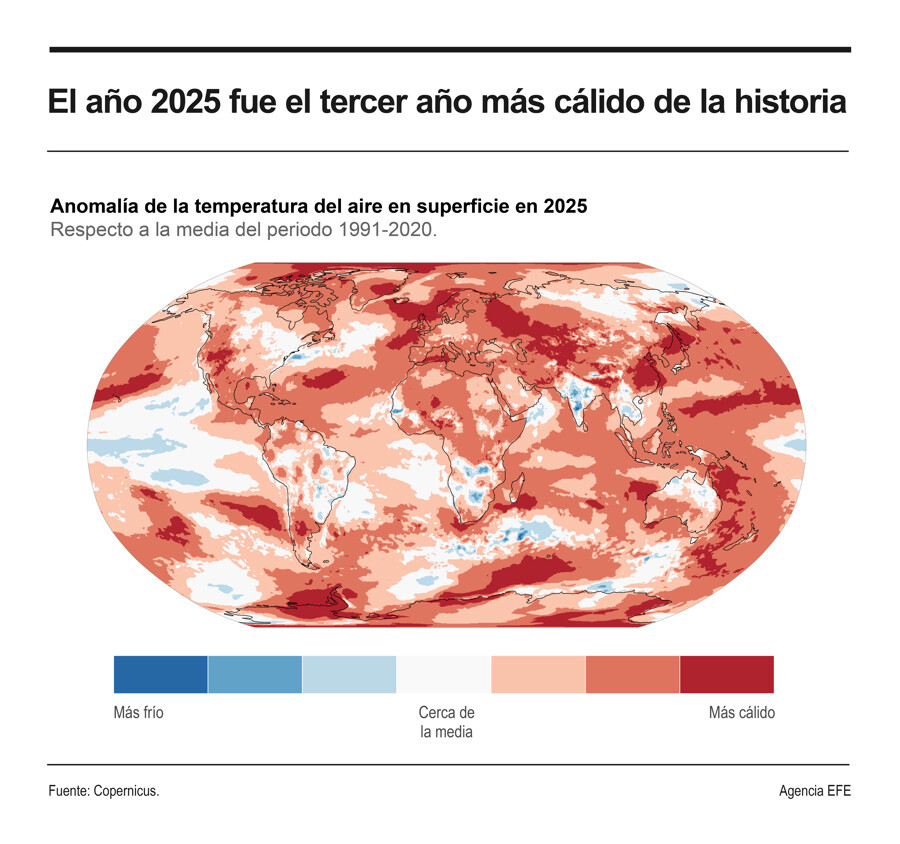
2025 was also the third warmest year for Europe, with an average temperature of 10.41 °C, 0.30 °C below the 2024 record and 1.17 °C above the average. Although 2025 was not the warmest on record, it contributed to the global temperatures of the last three years (2023-2025) «averaging more than 1.5 °C above the pre-industrial level (1850-1900), marking the first time a three-year period has exceeded the 1.5 °C limit». This was mainly due to the accumulation of greenhouse gases in the atmosphere and exceptionally high sea surface temperatures across the ocean, associated with the El Niño phenomenon and other oceanic variability factors, exacerbated by climate change. «None of us wanted to reach this milestone,» said Head of Earth Observation at the EC, Mauro Facchini. In 2025, the global average surface air temperature was 1.47 °C above the pre-industrial level (1850–1900), though below the 2024 level of 1.60 °C, the warmest year recorded. The current level of long-term global warming is around 1.4 °C above the pre-industrial level, so the 1.5 °C limit set by the Paris Agreement «could be reached by the end of this decade, more than a decade earlier than forecast,» according to the current warming rate. The year 2025 was the third warmest on record, but since 2023, it is the first time that in a three-year period, global temperatures have averaged more than 1.5 °C compared to the pre-industrial level, the threshold set by the Paris Agreement to limit long-term global warming. «It's not a question of if, but when, as it could be this year, next year, or in two years,» warned Buontempo. The strategic climate lead at C3S, Samantha Burgess, stated in the report's presentation that «no country or city has escaped climate change». In fact, in 2025, half of the world's land surface experienced more days than usual with severe heat stress, defined as a heat index of 32 °C or higher and recognized by the World Health Organization (WHO) as the leading cause of climate-related deaths worldwide. High temperatures in dry and windy areas also contributed to the spread of wildfires, which produced toxic air pollutants, as was the case in parts of Europe, including Spain, and North America. Nevertheless, the ECMWF and Copernicus highlight that 2026 could be among the five warmest years, and another El Niño event may occur, i.e., a climatic event where the central and eastern Pacific Ocean waters experience anomalous warming and affect weather patterns worldwide. «It's only a matter of time.»