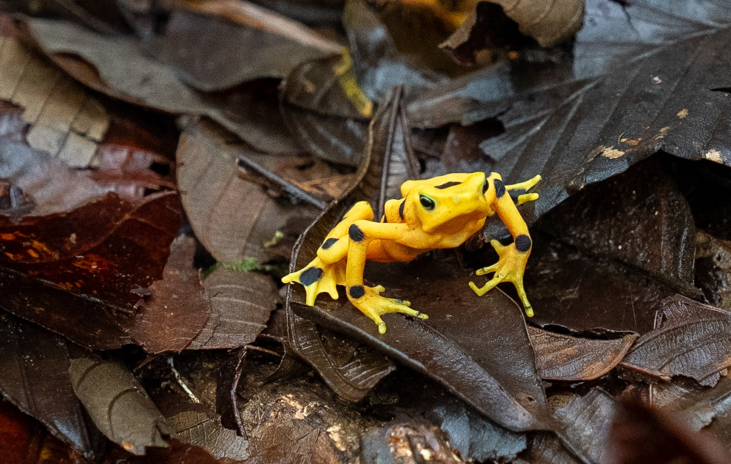
The Panamanian golden frog, critically endangered, has returned to the wild after the release of specimens bred in captivity, reported the Smithsonian Tropical Research Institute (STRI). Since 2009, no one had seen the Panamanian golden frog in the wild. Our observations here demonstrate that we can keep frogs in mesocosms for long periods, and if we find signs that they recover toxins from their skin, that will be important information to carry out our release trials in other places with a more favorable climate, it was stated. Before the golden frog release project, in 2025, three other species were released as part of the Tropical Amphibian Research Initiative (TARI). These bright yellow frogs disappeared completely when in 2004 the chytridiomycosis, a fungal disease that affects amphibians, spread through Panama and reached El Valle de Antón, the last bastion of the golden frogs. Therefore, the Smithsonian Tropical Research Institute (STRI) and the Smithsonian Conservation Biology Institute (SCBI) joined the Cheyenne Mountain Zoo and the New England Zoo to create the Panama Amphibian Rescue and Conservation Project (PARC) with the aim of protecting amphibians at the highest risk of extinction. After successfully breeding golden frogs and other species under human care, the project has begun releasing frogs to understand the science of reintroducing these endangered animals. We provide care for some of the most threatened amphibian species in Panama, and now we are entering a new phase of our work to study the science of reintroduction into the wild, stated Roberto Ibáñez, a STRI scientist and director of the Panama Amphibian Rescue and Conservation Project. According to STRI, in the first phase, 100 golden frogs were released in progressive release enclosures, known as mesocosms, and researchers returned to monitor them after the release. The frogs initially spent 12 weeks in the mesocosms, and around 70% of the animals died from chytridiomycosis. Many of the remaining frogs were fully released after the 12-week trial. The crucial data will serve as the basis for the conservation strategy in the future, stated Brian Gratwicke, a conservation biologist at SCBI. Our previous models suggested that we could select release sites that were climate refugia, i.e., places suitable for frogs but too warm for the fungus. Among them were the crowned frog (Triprion spinosus), Pratt's rocket frog (Colostethus pratti), and the lemur leaf frog (Agalychnis lemur). The release trials have exceeded the researchers' expectations, with excellent survival rates for the lemur leaf frogs, while passive acoustic monitoring indicates that the crowned frogs and Pratt's rocket frogs are also surviving. Although that figure may seem high, the data collected from the deceased frogs will be used to understand the dynamics of the disease and how the animals recover the toxicity of their skin after consuming a wild diet.