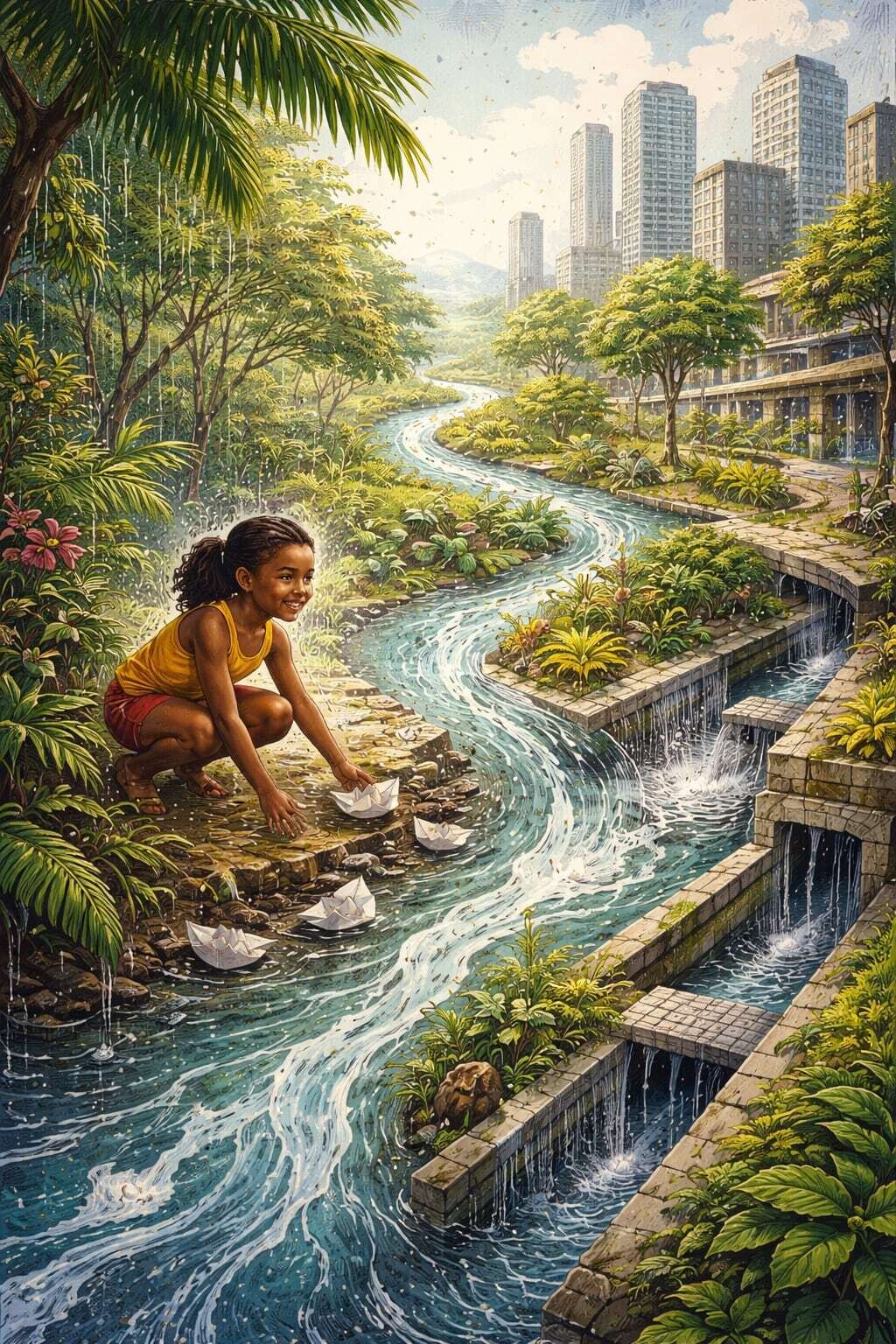
Only in this way can we affirm, with full certainty, that we know how to care for and coexist with our most valuable resource: water. The author is an architect and a student of the Master's in Landscape Design and Environmental Management at the University of Panama. It is essential to promote sustainable and healthy urban design and transportation systems, with better land use, access to green and blue public spaces, and prioritizing walking, cycling, and public transport. In this context, we must allow water to infiltrate the soil through natural processes such as capillarity, which feeds aquifers and maintains the constant flow of rivers and streams, preventing the vulnerability of ecosystems during the dry season. This also reduces the overload on sewer systems and leverages the soil's capacity to naturally filter pollutants. All these benefits bring us back to the starting point: infiltrating water into the soil is restoring its ability to absorb, store, and protect our most important resource, rather than expelling it as quickly as possible. We should take pride in being a country blessed with abundant fresh water and biodiversity, but this must go hand in hand with the implementation of these strategies. It is clear that the problem is not a lack of water, but how we manage it. According to the Ministry of the Environment, Panama's National Water Security Plan 2015-2050 states that the country has water in extraordinary quantities, supported by an average annual precipitation of 2,924 liters per square meter. Restoring the water footprint and its cycles is as important as reducing carbon emissions. That is to say, promoting harmony between urban and economic development and the natural cycles of water, emphasizing ecological sustainability and resilience to natural disasters. This is pointed out in the COP26 report, in its recommendation number 6: “Reimagining urban environments, transport, and mobility. It is not just about channeling or burying water through hydraulic solutions, but about breaking this vicious cycle and transforming our way of thinking as a society: stop prioritizing gray infrastructure as the first option and move towards comprehensive management based on green and blue infrastructure solutions throughout the territory. The sustainable development of Panama implies implementing public policies that recognize climate resilience as a central axis. As children, it was common to stop and watch how the rain drew furrows in the earth, while paper boats followed the current. Today, on the way to work, it is frequent to see how water falls from the roofs and flows forcefully over impermeable surfaces towards the sewers, often collapsing the system, causing floods, and then continuing, without further ado, its path to the sea. Normalizing this waste, without questioning it, evidences our profound disconnection from water, its cycles, and its use, aspects that we are neglecting due to a lack of environmental literacy.