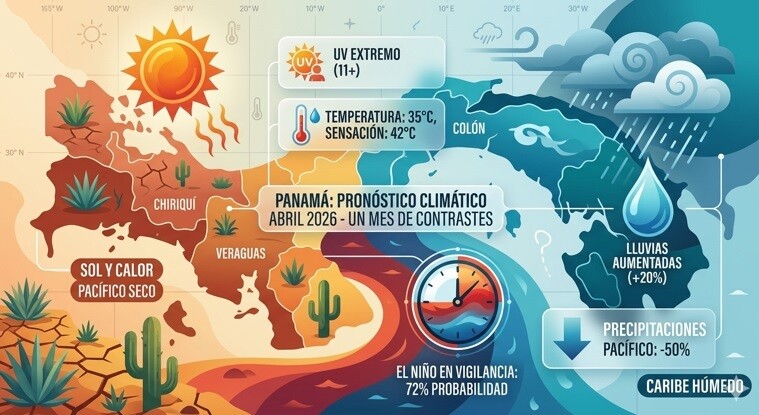
While the Pacific withers, the province of Colón experiences the other side of the coin with a 20% increase in rainfall, creating a chaotic contrast. The 'El Niño' phenomenon looms with a 72% probability. 'We are warning the different sectors about the imminent development of the El Niño phenomenon,' stated Graciela de Calzadilla, director general of the Institute of Meteorology and Hydrology of Panama (Imhpa). The latest report from the Institute of Meteorology and Hydrology of Panama (Imhpa) for April 2026 is not just a forecast, it is a climate sentence. Authorities have confirmed what many feared: a brutal transition to the rainy season, which is fraught with dangers, temperatures that touch hell, and a dramatic decrease in rainfall that threatens to dry up the fields of the Pacific. The Pacific is drying up! The official bulletin reveals that in provinces such as Chiriquí, Veraguas, West Panama, and Darién, rainfall could plummet by as much as 50%. Half of the expected water simply will not arrive! The thermometers show no mercy: maximum temperatures are hitting 35°C, but the heat index is a true torture, reaching up to 42°C. Imhpa has been direct: the risk of vegetation fires is critical, and the health of the population is on the front line. Although some isolated showers are expected in the afternoons, the general outlook is for clear skies and an unrelenting sun that is evaporating the hopes of farmers. The transition to the rainy season has been delayed, and what comes next could be one of the most critical periods in recent years. The climate is unforgiving, and Panama is in the eye of the dry storm! The crisis is just beginning! Authorities are asking the population not to expose themselves to the sun and to save every drop of water. The probability is a terrifying 72% for the quarter beginning in May. The masses of warm water detected in the equatorial Pacific are the harbinger of a crisis that could strike the economy and water supply of all Panamanians. Deadly radiation and terrifying heat. Ultraviolet radiation indices have reached 'extreme' levels, oscillating between 8 and 11+. The country is under fire!