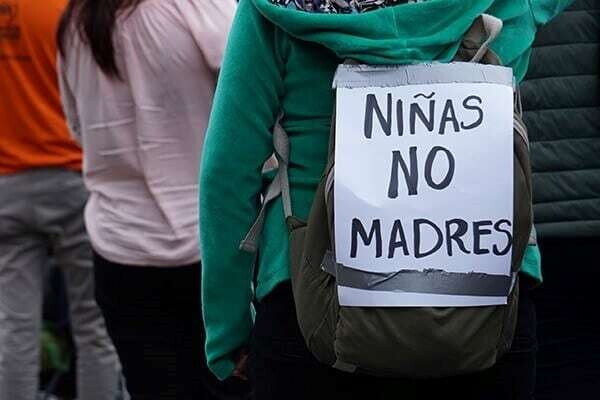
In Panama, most teenage pregnancies involve adult men; however, not all men abuse girls. Teenage pregnancy is, above all, an issue of adult men. But, although this constitutes a crime, conversations on this topic often point to girls. The consequences for girls are enormous: family rejection, school exclusion, and even obstetric violence. As long as the focus remains on girls and not on adult men, the problem will not change. Elsewhere in the city, in an office, a colleague is stopped because it's not funny to talk about how 'good' a female colleague looks: that is sexual harassment. According to a recent CIEPS survey, 79% of people in Panama believe that pregnancy occurs due to the irresponsible behavior of teenagers. It is a culture that turns minors into triple victims: of abuse by an older person, of public stigmatization, and of the burden of care. For men to join the conversation, especially from a prevention standpoint, is key to breaking this cycle. Why don't they close their legs or are they provocative, where are the parents or they know what they are doing. Anthropologist Rita Laura Segato, who has researched and written about this for decades, explains that the mandate of masculinity forces men to exhibit and demonstrate to other men that they are men, to validate their condition: for them to recognize them as someone deserving of this male position. Male spectators (fathers, brothers, friends, colleagues) can do a lot to weaken or transform that masculine culture that normalizes abuse of minors or many other things. This is not an invitation to start a revolution, but to examine everyday acts: sending a message, stopping a joke, leaving a WhatsApp group, not looking the other way when something is uncomfortable. Where are those men and what can they do to change the reality? Official figures reveal a reality that is rarely focused on: of the 24 girls and adolescents who become mothers every day, 18 do so as a result of relationships with men at least five years older than them. Teenage pregnancy cannot be explained without looking at those who make it possible. And at a family gathering, a nephew tells his uncle to go get his own food, his aunt already did enough by cooking. If each of the men—who do not have relationships with minors—does or says something, something moves; because masculinity is built and legitimized among peers. The examples are scary. Because the typical abuser 'is not a deviant' or 'an exceptional case', he is 'a normal guy in every sense'. Some examples: one day a man leaves a WhatsApp group where photos of semi-naked women are shared, after pointing out that this is a violation of privacy and can be a crime. Society usually perceives it that way. That is why, transforming masculine culture is part of the solution. That is what American educator and author Jackson Katz points to in a TE D talk: 'If we manage to make men who act in a sexist way lose status, we will see a radical decrease in abuse'. This column was produced in the 'Think Panama/ Narrate Democracy' Writing Program, by Concolón and the British Embassy in Panama. Without that change among peers, no public policy will be enough. The author is a sociologist, with training in human rights and gender. Executive Director of Aplafa.