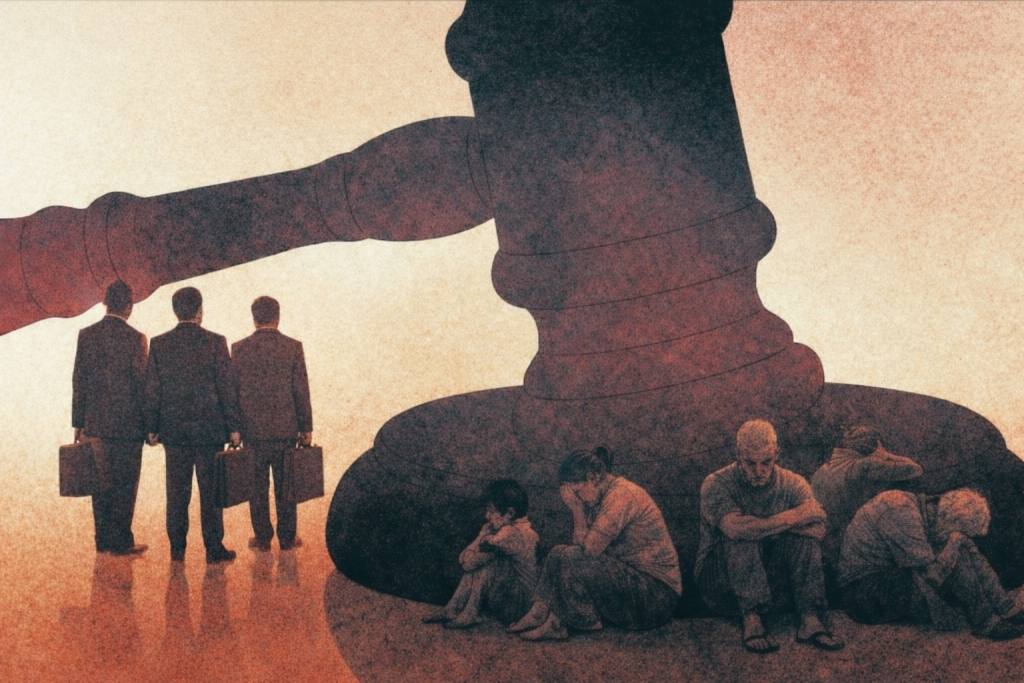
Lawyers Warn of Deteriorating Criminal Justice in Panama
Lawyers Luis Fuentes Montenegro and Marco Austin warned that Panama is facing an increasingly negative public perception of its justice system, primarily in the criminal sphere, where the independence of the judiciary, selectivity in proceedings, and a lack of certainty of punishment are being questioned.
Fuentes Montenegro stated that the unfavorable assessment should not automatically extend to all jurisdictions, as there are substantial differences between criminal, civil, and administrative justice. However, he acknowledged that it is precisely in the criminal area where the most significant allegations of partiality, alleged political collusion, and a lack of real independence are concentrated.
“The problem is focused on criminal justice. There are very capable prosecutors, but these networks do not give them space,” he affirmed, pointing out that the selectivity of actions often depends on “who you are and what power you have.”
In his view, the effectiveness of the Public Prosecutor's Office is “undermined,” and any profound transformation will be complex due to internal regulations created to preserve privileges and hinder real changes in the prosecutorial career.
The Common Citizen, the Main Victim
Fuentes Montenegro emphasized that the common citizen feels unprotected against the system, perceiving the existence of “two classes of justice”: one lenient towards the powerful and another relentless towards those without political influence or economic advantages.
In this context, he supported the recent dismissal of a prosecutor, without detailing the case, considering it to be “solidly grounded” and serving as a clear message that no official can hide behind their position to abuse or overstep their authority.
“If a prosecutor does not act correctly, they should not be a prosecutor. There can be no untouchables,” he stated.
“There is no real judicial independence,” says Austin
In turn, lawyer Marco Austin agreed that the administration of justice in 2025 has favored internal interests more than the benefit of the Panamanian people, especially in rulings related to high-impact social problems.
“There is interference between state organs, and this prevents justice from being applied impartially,” he stated.
Austin indicated that the Public Prosecutor's Office could work much better for the population, but its management has been affected by external interference and a high perception of impunity, which severely weakens institutional credibility.
“The great debt of the judicial system is the certainty of punishment, both in high-profile cases and in those that are not. Justice must be effective for everyone,” he affirmed.
Regarding recent rulings by the Supreme Court of Justice related to prosecutors, Austin warned that it evidences the absence of a true judicial career in the Public Prosecutor's Office, which he considers dangerous for the impartiality of investigations.
“The Court, with these decisions, ratifies that in Panama there is no fully impartial administration of justice. Selectivity, differentiated treatment, and a feeling that political and economic power influences decisions are perceived there,” he affirmed.
The lawyer warned that the highest authorities of the judicial system must urgently strengthen the independence of criminal justice, as the lack of corrective actions could lead to “very unfortunate social situations” in the short term.
Public Prosecutor's Office in a Credibility Crisis
Regarding the Public Prosecutor's Office, Fuentes Montenegro was forceful in stating that the institution has faced a deteriorating image for years, and that the replacement of the Attorney General alone does not guarantee structural changes.
“Internally, networks and substructures that self-protect, grant benefits, and cover questionable practices subsist. Beyond whether a prosecutor acted well or not, what must prevail is the strict compliance with due process in all cases,” he concluded.