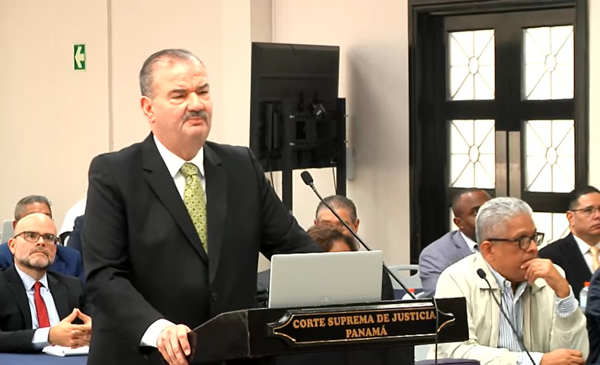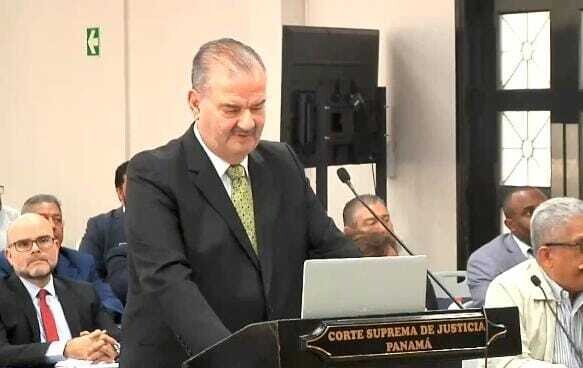
The defense of former President Ricardo Martinelli, represented by lawyer Carlos Carrillo, argued in its pleadings that the judicial process against him is tainted by multiple irregularities, including the violation of the principle of specialty in his extradition, the use of evidence declared null in Brazil, and the alleged lack of judicial guarantees. Therefore, it requested the annulment of the process and the acquittal of his client. Carrillo stated that on July 11, 2024, the Ministry of Foreign Affairs of Panama certified that the principle of specialty was never fulfilled after the extradition granted by the U.S. Department of State. According to the defense, Panama did not request the corresponding authorization to prosecute facts different from those included in the delivery of the former head of state, which, in their opinion, invalidates the criminal prosecution. The lawyer also challenged the composition of the tribunal, alleging that the appointment of an 'ad hoc' judge violates the right to a natural judge enshrined in the American Convention on Human Rights. In this sense, he requested that the nullity of all proceedings be declared and judicial guarantees be restored. Another of the defense's axes was the validity of the evidence. Carrillo argued that the case is based on evidence from Brazil linked to the construction company Odebrecht, which has been declared legally void by the Federal Supreme Court of Brazil. He added that even Brazilian authorities extended the effects of those decisions in favor of Martinelli, so he insisted that such evidence cannot be valued in Panama without violating due process. The defense also denounced that it was unable to cross-examine key witnesses such as João Santana and Mónica Moura, which left the former head of state in a state of defenselessness. It indicated that there were official communications warning about the impossibility of carrying out these procedures, despite which the Public Prosecutor's Office intends to base the accusation on those testimonies. On the matter of evidence, Carrillo also questioned the chain of custody of digital evidence, pointing to the absence of forensic certifications and technical verification of the data sent from abroad, including information from the United States and Switzerland. To this, he added the alleged violation of Martinelli's parliamentary immunity as a deputy of the Central American Parliament (Parlacen), indicating that several pieces of evidence were collected during a period in which he had that protection. Regarding the merits of the case, the defense maintained that the funds attributed to the former president had justification as political donations channeled to the Cambio Democrático party. As he explained, a financial expert determined that the resources were used in campaign activities and reported to the Electoral Tribunal, which rules out the existence of money laundering. Carrillo also emphasized that the Public Prosecutor's Office did not present financial traceability experts to support the accusation, while the evidence itself reveals that not all funds handled in the investigated structures had an illicit origin. Finally, the lawyer reiterated that, given the alleged contamination of the evidence, which he described as a 'poisoned tree,' the tribunal cannot value it without departing from the law, so he requested not only the annulment of the process but also an acquittal in favor of his client.