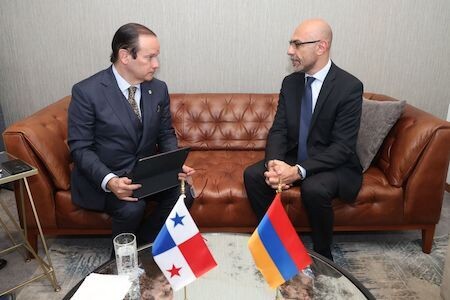
During his official visit to Mexico, Minister of Foreign Affairs, Javier Martínez-Acha Vásquez, held the First Meeting of Mexico's Concurrent Ambassadors in Panama. This occasion allowed him to hold bilateral meetings with the diplomatic representatives of 12 countries and to invite them to adhere to the Permanent Neutrality Treaty Protocol for the Panama Canal.
According to the Panamanian Ministry of Foreign Affairs, during the meetings with the concurrent ambassadors in Panama, Minister Martínez-Acha Vásquez proposed joining the Permanent Neutrality Treaty of the interoceanic route as a legal guarantee for world trade, a political signal of support for international law, and a concrete act of trust in Panama as a safe, stable, and predictable country.
The meetings were held with Messaoud Mehila, ambassador of the People's Democratic Republic of Algeria; Rachel Moseley, ambassador of the Commonwealth of Australia; Seymur Fataliyev, ambassador of the Republic of Azerbaijan; Milan Cigán, ambassador of the Slovak Republic; Shozab Abbas, ambassador of the Islamic Republic of Pakistan; Arvin Reyes De León, ambassador of the Republic of the Philippines; Adli Qasem Alkhaledi, ambassador of the Hashemite Kingdom of Jordan; Nguyen Van Hai, ambassador of the Socialist Republic of Vietnam; and the ambassador of the Republic of Côte d'Ivoire, Ly Djerou Robert.
It also included Hayk Hakobyan, chargé d'affaires of the Republic of Armenia; Nikoloz Sakhvadze, Chargé d'Affaires of Georgia; and Milos Markovic, chargé d'affaires of the Republic of Serbia.
Minister Martínez-Acha Vásquez presented Panama as a global logistics, port, and aviation hub, highlighting the country's strategic position as an interoceanic connector and regional platform, linked to MERCOSUR of which it is an associate member.
He also promoted investments in ports, infrastructure, renewable energies, semiconductors, maritime logistics, and air connectivity, including possible agreements with airlines, in the case of Australia, and opportunities with Asia and West Africa.
Furthermore, Panama's head of diplomacy addressed the concurrent ambassadors in Panama on cooperation in sustainability, climate change, and the green transition.
He addressed initiatives linked to COP31 and COP17, Panama's environmental leadership as a carbon-negative country, and cooperation in clean energy, technological agriculture, and climate mobility, positioning Panama as a serious, pragmatic, and committed environmental partner.