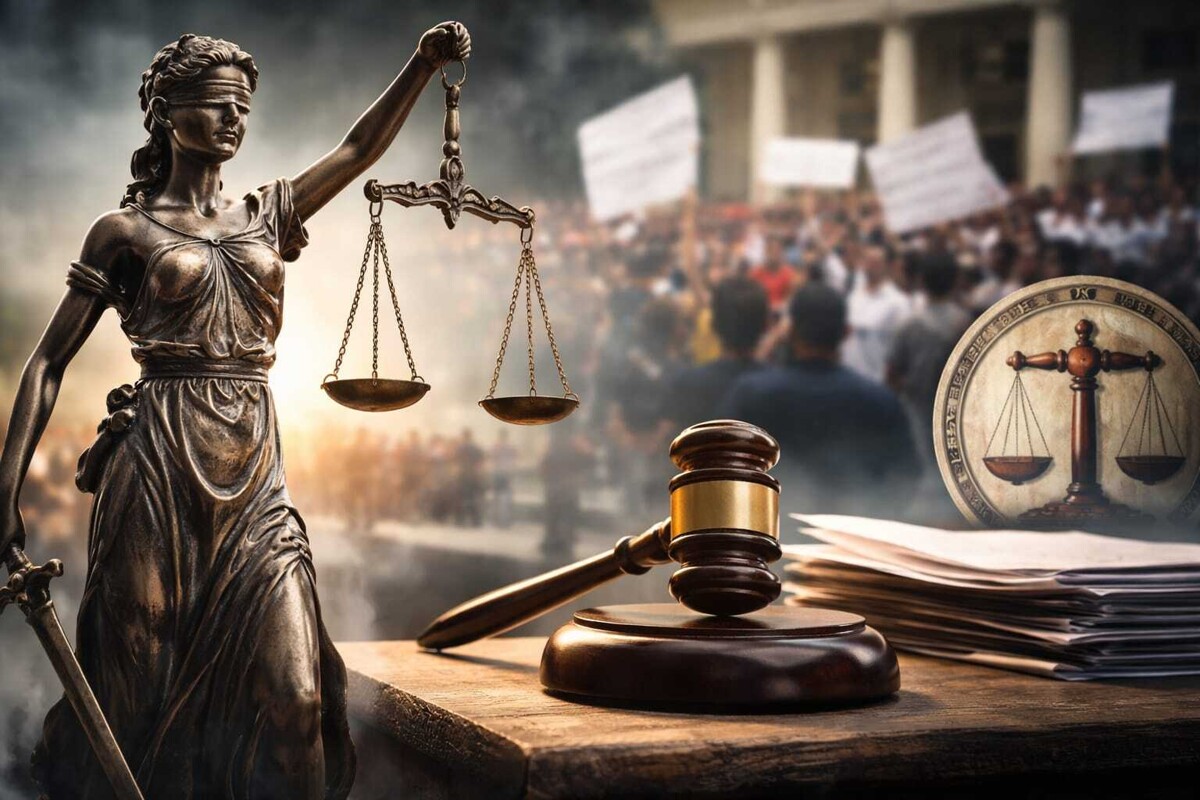
Citizens are beginning to believe that justice does not exist or is ineffective,” it is indicated. In a social context where tensions and citizen demands are increasing, the weakness of the judicial system becomes an additional risk factor. Justice, which should be the pillar that supports social order, thus faces the challenge of regaining credibility amid growing criticism. Meanwhile, on the street, perception seems to move faster than court files. Slow and selective justice leaves citizens without confidence. Fuentes Montenegro warns that there are external factors that directly influence the pace and direction of judicial processes. He points out that, although in theory all cases should be treated with equality, in practice, interests intervene that alter that premise. “No case should be a priority over another. Cases that drag on for years, decisions that generate doubts, and disparate results have set off alarms. Structural failures and a system that doesn't take off. Lawyer Luis Fuentes Montenegro states that reducing the problem to a single cause would be to simplify a complex situation with multiple structural failures. In his opinion, the Accusatory Penal System, which was once presented as a modern and efficient solution, has not met expectations in practice. “There are multiple factors. The accusatory penal system in practice has not been as effective as predicted, and often the lack of impartiality comes to light,” he explained. This lack of impartiality, according to the jurist, is one of the elements that most damages the credibility of the system, as it opens the door to suspicions about the transparency of decision-making. Influences, power, and unequal justice. But the problem does not stop at the technical level. The slowness in processes and the growing perception of selectivity in the application of the law are weakening citizens' confidence in a system that, for many, no longer guarantees equality. In the midst of this reality, jurists warn that the problem is not new, but it is increasingly evident. But reasons such as political maneuvering, the intention to curry favor with the in-power group, and the pressure from certain media aligned with political and economic interests intervene,” he stated. These statements put a sensitive issue on the table: the possible interference of de facto powers in the administration of justice, a perception that has been gaining ground in public opinion. The most severe criticism points to the unequal application of the law, especially when comparing cases of different social and economic profiles. For Fuentes Montenegro, the system acts firmly against certain sectors but loses strength when facing more complex power structures. “The Penal Law has been consolidating itself as an implacable instrument against those who believe they are trees without shade… but when it comes to white-collar groups, economic organized crime intertwined with political power, it is dysfunctional, complicit, and weak,” he maintained. In the same vein, lawyer and former deputy Guillermo Cochez agrees that the slowness of justice has a direct impact on citizen perception. He assures that there is a widespread feeling of inequality in access to and application of justice, especially among those who do not have financial resources. “There is a perception that justice is applied only for the little people, those who don't have famous lawyers,” he expressed. Cochez also warns that processes can extend for years, particularly when those involved have the ability to appeal to higher instances. “Those with resources go to the Supreme Court and delay for three or four years processes in which they have already been convicted,” he pointed out. According to the former deputy, these delays are not always a product of the system's workload, but in some cases respond to legal strategies to buy time. “What they seek is to see in what way they can be freed by influences and other things that happen quite frequently in our judicial system,” he added. Citizen distrust. Both jurists agree that the deepest damage is not only in the accumulating files but in the perception that justice does not operate with equity. That perception, they warn, can have dangerous consequences for the country's institutional stability. Fuentes Montenegro alerts that the lack of confidence in the penal system can lead citizens to question its legitimacy. “This generates more distrust in the penal system. To say that a single cause produces such delays would be mistaken.