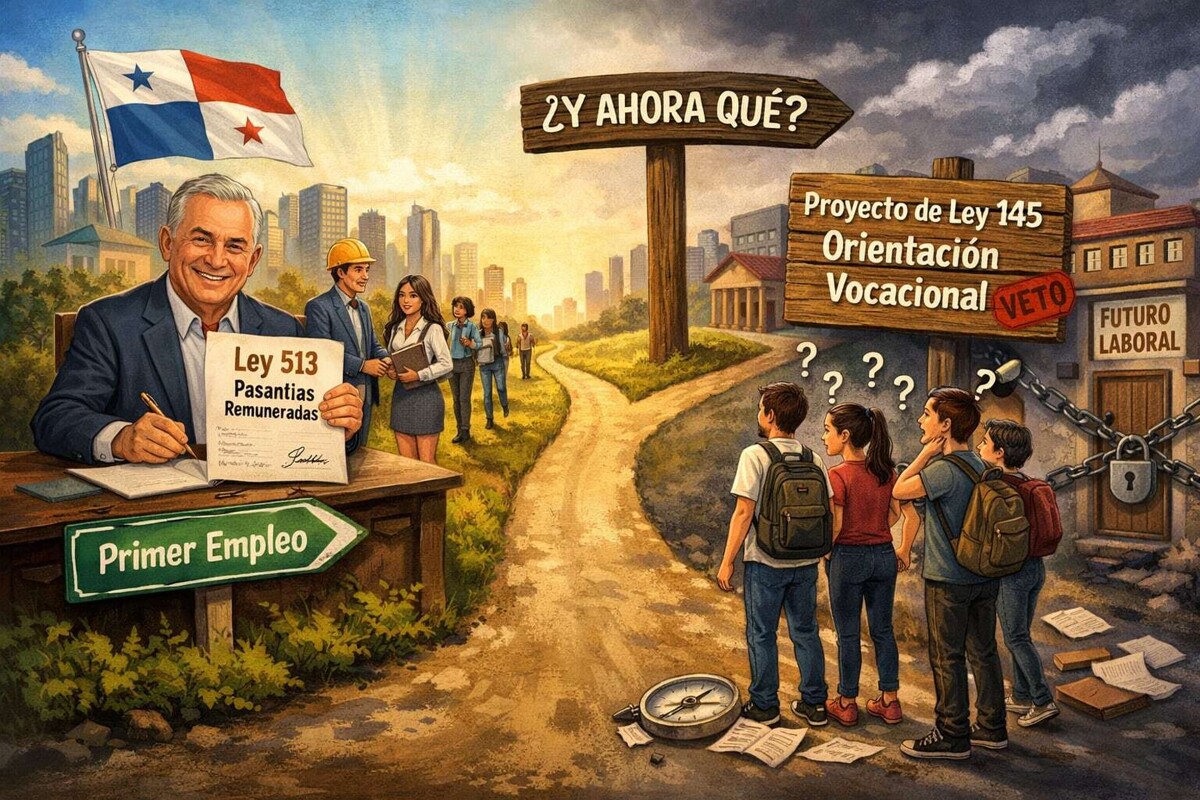
Vocational guidance should not need a law to exist. The academy has preferred to fill classrooms with Law, Administration, and Accounting students rather than ask if this aligns with any national development strategy. The veto on Project 145 should not, then, be interpreted as a failure of the Legislature. It should be the heart of any educational system that takes its mission seriously. But, as long as universities and the Ministry of Education continue to wait for the State to tell them exactly what to do, when to do it, and with what budget, young Panamanians will continue to choose careers out of inertia, family tradition, or the illusion of a degree that the market no longer needs. It is a message to the Panamanian academy: vocational guidance is its problem, not the State's. And in that, paradoxically, the president is right, although not in the sense he intends. In other words: the problem was not the objective of the law, but who should execute it. Because, if anything is clear from this episode, it is that the country's universities and colleges have been evading that responsibility for decades. How many faculties of education, how many departments of student welfare, how many professional orientation programs exist today in Panama's public universities with the real capacity to guide a 17-year-old toward a career that matches their aptitudes and the country's needs? The message from the Executive was clear, although probably not in the way he intended: in Panama, we can open the door to the first job, but we refuse to teach young people how to find it. Let's review the facts. Four days later, that same president vetoed Bill 145, which sought to establish a vocational guidance policy for young people. The bill was passed with 45 votes; however, the Executive blocked it. The arguments for the veto deserve to be read carefully, as they reveal something deeper than a bureaucratic dispute. The president argued for possible conflicts of competence between the Ministry of Labor and Labor Development, the education system, and universities regarding orientation and certification. Panama has an internship law that, on paper, is a valuable instrument. The program is aimed at young people in academic training from secondary, university, vocational, or technical education, and gives them the opportunity to participate in companies to develop their skills. But an internship without prior orientation is like handing someone a map without having taught them how to read it. Mulino's veto is not just an administrative decision. It should be read as a forced, though clumsy, invitation for educational institutions to assume what has always been their responsibility. On March 20, President José Raúl Mulino signed Law 513, making Panama the first country in Latin America to regulate paid internships. Panama took an important step with the Internship Law. And then they will arrive at that internship for $450 a month without knowing very well why they are there. This is the pattern that should concern us. Bill 145 arose precisely from an undeniable reality: the saturation of traditional university careers, which has generated a significant deficit in the labor market. The proposal, promoted by Deputy Ariel Vallarino, was comfortably approved with 45 votes in the National Assembly. But one step alone doesn't get you anywhere if you don't know where you are walking. The author is a multidisciplinary professional: Industrial engineer, internationalist, and lawyer. The answer is harsh: very few do it seriously. But in the face of that doubt, the Executive's response was simply to do nothing. An advance celebrated, applauded, photographed.