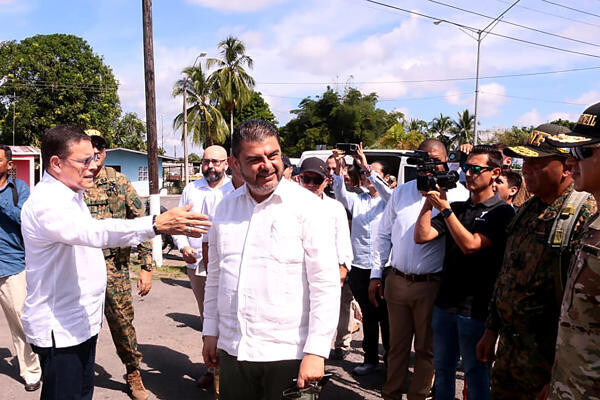
Panama and Costa Rica this Saturday consolidated a strategic alliance to reinforce security on their common border and jointly confront transnational organized crime, within the framework of a high-level bilateral meeting held in the border area of Paso Canoas, in the Panamanian province of Chiriquí, reported the Ministry of Security of Panama. "(The effort) strengthens the digital control of the border and allows for a more effective response against organized crime," highlighted Panama's Minister of Public Security, Frank Abrego, and also emphasized that "the operational integration between both countries elevates the capacity for anticipation and reaction against threats". During the meeting, Abrego and his Costa Rican counterpart, Mario Zamora Cordero, reaffirmed the commitment of both countries to deepen binational cooperation, with special emphasis on the protection of the territory and citizen security. Paso Canoas constitutes a nerve-wracking customs office for the region, as merchandise that arrives in Panama through the interoceanic Canal and the Colón Free Zone (ZLC) passes through it, destined for its commercialization in Central America, as well as regional products for export. In turn, the Costa Rican minister described the meeting as "effective and beneficial", and highlighted the importance of "sustained police cooperation that allows confronting, with greater forcefulness, the criminal structures operating in the region". As part of the agenda, according to official information, the authorities inaugurated a new Operations Center of the National Border Service (SENAFRONT) in the Progreso sector, destined to strengthen the monitoring and control of the area through surveillance technology, including cameras and drones, as well as the exchange of real-time information between both countries. Likewise, the delivery of eight vehicles to reinforce patrolling in the area was announced, along with the intensification of joint operations at strategic points on the border. The authorities indicated that these measures will allow for a greater operational presence, a better response capacity, and greater tranquility for the border communities. Both ministers agreed that the coordination between Panama and Costa Rica has contributed to maintaining a "calm, stable, and developing" border, and announced that in future meetings, including one in San José, new agreements will be promoted to deepen cooperation in security matters. In this context, in February 2024, authorities from both countries inaugurated, on the Costa Rican side, the Paso Canoas Integrated Control Center, a 14,000-square-meter facility conceived to expedite procedures and the flow of the nearly 200 cargo trucks and 800 people who cross the border daily from Panama. The meeting brought together high commands of the public forces of both nations, who advanced in the articulation of joint strategies to combat threats such as drug trafficking, human trafficking, and smuggling, under a coordinated action approach and intelligence exchange. This binational approach reaffirms the commitment of both countries to guarantee the security of their citizens and sends a clear message of joint action against organized crime.