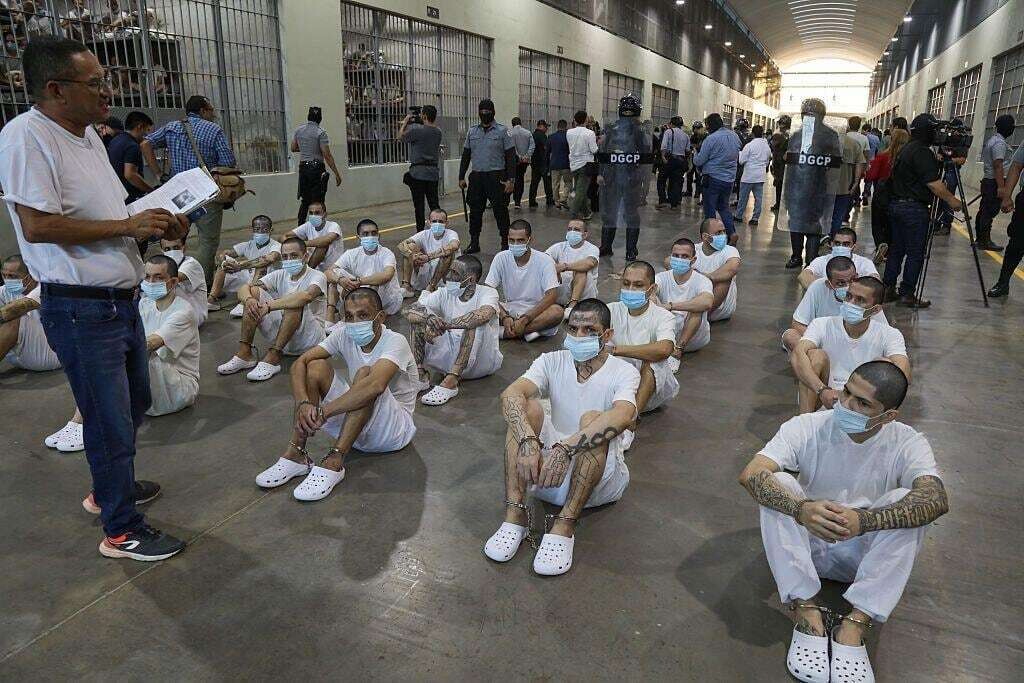
These perceptions of insecurity need to be addressed as they can have consequences for the system of freedoms. On the other hand, Panamanian prisons suffer from overcrowding, but tackling this problem by building a mega-prison under a state of emergency contravenes the principles of rehabilitation and human rights. The question these data raise is whether this type of policy is truly the choice of the citizenry and to what extent society is willing to cross certain limits. During the state of emergency, the Salvadoran government managed to reduce the homicide rate to historic levels, especially in the first three years of this exceptional regime. The construction of mega-prisons has been copied by other Central American countries like Costa Rica and Guatemala, which consolidates it as an alternative to solve public security problems in the region. Panama is the fourth country in the region that best values the Salvadoran president, after El Salvador, Honduras, and Ecuador, countries that have suffered from much greater security problems than the isthmus, with much higher homicide rates. According to the Integrated System of Criminal Statistics (SIEC), the isthmus suffers a moderate homicide rate, meaning it is not high, but it does require attention: 12 homicides per 100,000 inhabitants in the country compared to 20 per 100,000 in the region. Could the country accept a long state of emergency that implies imprisoning thousands of people who have no known crimes? But more importantly, is it acceptable to suspend basic principles of the rule of law, such as the presumption of innocence or the right to defense, to grant extrajudicial powers to authorities? If the answers to these questions are affirmative, it would imply a transition towards a process of institutional deterioration that would make it impossible to maintain that which, in a normative sense, defines republican institutions: that all are equal before the law. The author is a researcher at CIEPS. However, citizen perception places 72.3% of people in Panama as considering that the country is not safe, according to the IV Survey of Citizenship and Rights (CIEPS, 2025). 53.3% of people surveyed in 17 countries evaluate him positively or very positively (from 6 to 10 on a scale of 0 to 10), the best-rated leader above other Latin American or international leaders, even better rated than the Pope himself, in a predominantly Catholic region. In Panama's case, this percentage is even higher, reaching 78.2% who positively or very positively value the Salvadoran president, 33 points above the rating of the Holy Father, who occupies second place after the Salvadoran leader. The Center for Confinement of Terrorism (CECOT) in El Salvador is a maximum-security mega-prison inaugurated in 2023 in Tecoluca, designed to house over 40,000 gang members. In 2025, in an article published by the newspaper El País, it was revealed that the Bukele government prevented an investigation being carried out from the United States into the relationship of Salvadoran authorities with the MS-13 gang and prevented some of its members from being extradited to be interrogated. According to the Latinobarómetro 2024, Nayib Bukele is the best-rated leader among the 17 countries consulted in Latin America and the Caribbean. At the end of March 2026, the International Federation for Human Rights (FIDH) presented on its website the results of a report by international jurists denouncing the existence of crimes against humanity in El Salvador. Salvadoran security policy has been tarnished by scandals. Recently, in another investigation based on internal intelligence documents, it was revealed that 36% of those captured during the state of emergency did not appear in police records as gang members prior to the decree of the state of emergency regime, leaving a figure of more than 33,000 imprisoned without a known criminal cause. But, despite this information, it is striking that, following survey data, this type of policy apparently has very good acceptance in the region. The CECOT is a cornerstone of President Nayib Bukele's security policy, characterized by total isolation, extreme surveillance, and the absence of visits. Since coming to power in 2019, Bukele has renewed the state of emergency 48 times, which has allowed him to capture a significant contingent of gang members. However, on the other hand, the CECOT is subject to complaints from human rights organizations for the non-compliance of guarantees and minimum freedoms. Is society sure about adopting these measures, even if they do not respect the rights or basic guarantees of the entire population?