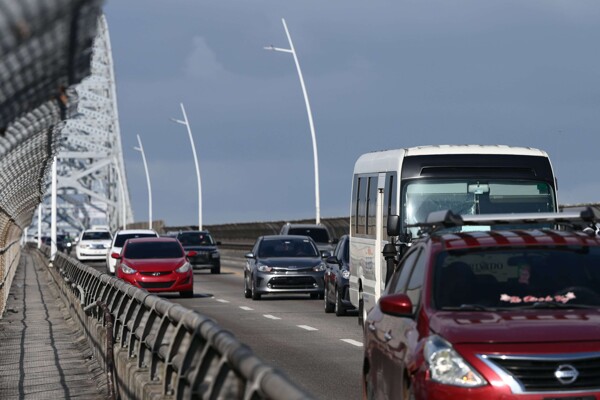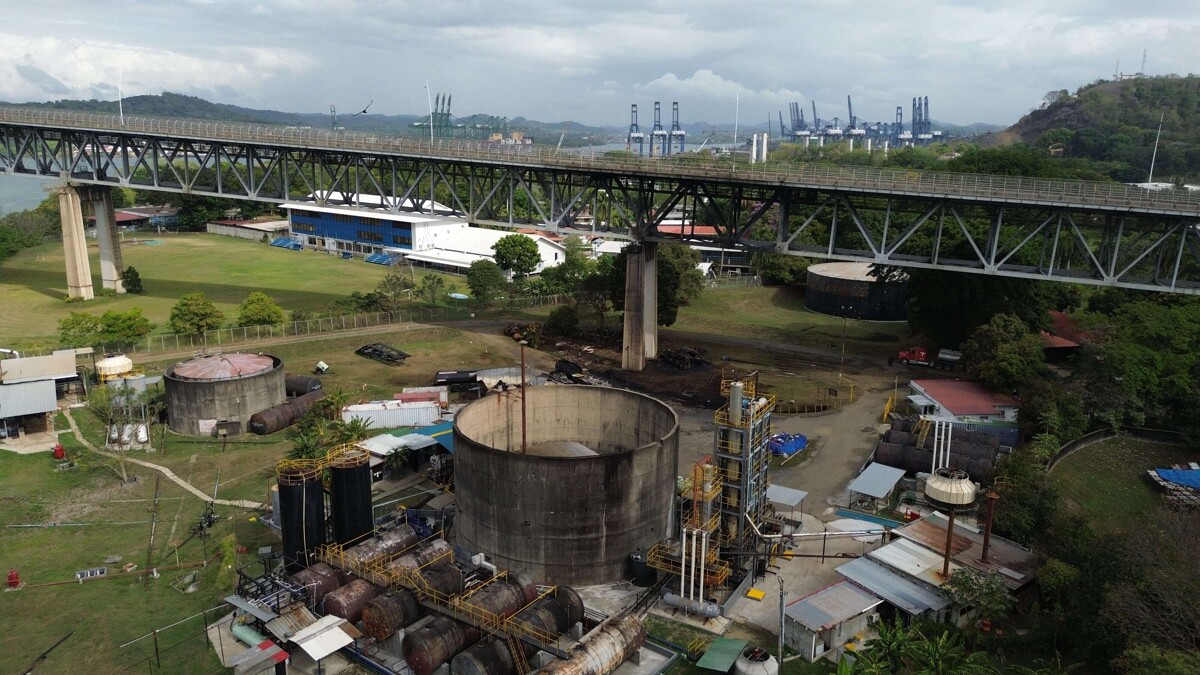
Nearby residents, such as those in the Tabernilla community in La Boca, have been warning for months about strong fuel odors. As Domínguez recalled, the tanks were installed after the bridge's construction in 1962 and currently show visible signs of deterioration, especially corrosion on their surfaces. Meanwhile, structural engineer and member of the Panamanian Society of Engineers and Architects (SPIA), Rogelio Dumanoir, also questioned the conditions under which fuel operations were being carried out near the Bridge of the Americas and warned about possible failures in the application of current safety standards. Dumanoir acknowledged that the Ministry of Public Works (MOP) acted appropriately by subjecting the bridge to a technical evaluation; however, he emphasized that there is a greater concern related to fuel handling in the disaster area. "How was it possible that a fuel transfer operation between vehicles was being carried out so close to the bridge's pier?" he questioned. The fire of three tankers near the Bridge of the Americas on April 6 has reignited the debate about the structural condition of this key route and the location of these fuel reserve tanks, after the MOP authorized its partial reopening with restrictions for heavy vehicles while technical evaluations continue. Following the incident—which generated a large fireball that reached one of the bridge's columns and its roadway surface—the MOP reported that, preliminarily, no severe structural damage was observed in the trusses, although additional tests will be conducted. Precisely, U.S. Army engineers will arrive in the country this Thursday, April 9, to voluntarily assist in the structural inspection of the Bridge of the Americas. In his opinion, if there was no structural impact, traffic should be fully restored; otherwise, he warned that they would be acting under a "trial and error" scheme, which he deemed inadequate for an infrastructure of this magnitude. The former minister also alerted to historical structural problems of the bridge, recalling that for more than three decades, studies had already warned of the need to replace components such as the slabs. Faced with this scenario, the specialist called for a thorough investigation into the causes of the fire and to determine responsibilities, warning that this type of incident cannot be minimized. He also questioned possible evasion of responsibilities by the area's concessionaire, reminding that regardless of subleases, it remains obligated to ensure compliance with the standards and conditions set by the State. As a warning, Domínguez expressed his concern that the case will go unpunished and that responsibility will fall solely on the person who died during the incident, so he insisted on the importance of ensuring transparency and accountability. Specialists warn about fuel tanks Domínguez also expressed concern about the condition of the fuel tanks located in the vicinity of La Boca in Ancón, currently concessioned to the company Panama Oil Terminals, S.A. (POTSA). These facilities correspond to the old fuel tank farm in Balboa (Pacific) and Cristóbal (Atlantic), which was once operated by Atlántico Pacífico, S.A. (APSA). "Gasoline is not stored here today, only bunker and diesel, that is, residual fuel," he stated in an interview with Telemetro Reporta. Quinn explained that recyclers collect residual oil from gas stations or ships; that they transport it, process it, and add value to it. "That is where the problem could have existed," he said, and explained that in the washing process solvents are used and that in those processes chemicals must participate, since a flashpoint test must be performed, which is the one that indicates the temperature at which a hydrocarbon generates explosive vapors. "That's why you see one, two, three explosions [in the Bridge of the Americas event], because you are no longer talking about residual, that is, bunker [...]", warned Quinn. He added that when a residual product is collected, you cannot trust that it does not have other contaminating elements, and that these contaminating elements are not added by chance, but to be able to wash the tank. "This tragedy could have had a different scope," he remarked, at the same time as he called for strengthening compliance with existing regulations. What could be behind the explosions Harry Quinn, an engineer specializing in hydrocarbons, drew attention to the operations taking place in the polygon managed by POTSA, where there are fuel storage tanks that were built in 1927. Within that polygon, there are two subcontractors, he indicated, one dedicated to lubricants and another to recycling. Likewise, he expressed doubts about possible damage to the concrete, being at a greater distance from the focus of the fire. Nevertheless, he criticized the decision to restrict the passage of heavy vehicles without a clear technical explanation. "The transporter is told to go and pick this up, he doesn't know what he is loading, he sees it black and says that's bunker, he indicated. He added that this type of activity is regulated by safety standards, especially in installations with overhead tanks and storage of large volumes of hydrocarbons. The specialist warned that the incident could have had much more serious consequences. "The trial has cost us cheaply. Currently, POTSA supposedly has part of the area leased to Environmental Solutions Development, Inc., dedicated to waste management and fumigation inside or outside port premises. The condition of these tanks is a concern following recent incidents in the area. "And that is the risk," stated Quinn. He also pointed to the terminal's manager, who is not a recycler. "If the paint remains adhered, it was difficult for there to be enough heat to weaken the metal structure," he stated. It is about two structural engineers and two support specialists, who will carry out a technical evaluation and issue a report that will be delivered to the MOP next Monday, April 13. MOP's evaluation was 'superficial' The former Minister of Public Works and engineer by profession, José Antonio Domínguez, described the official evaluation as "superficial", considering that doubts persist about other elements, such as the condition of the columns and the determination of responsibilities for what happened. Domínguez explained that when analyzing the images of the fire, it is appreciated that the flames remained below the steel structures of the bridge and were displaced by the wind, which—in his opinion—reduces the probability of a significant thermal impact. He maintained that the presence of soot, and not burnt or carbonized paint, would be an indication that the steel did not reach critical temperatures.