With nearly a thousand pages across two volumes, divided into six books, Smith examines the aspects of society that promote or inhibit prosperity, from the activities of commerce, production, and distribution to the agricultural and educational systems of the known world.
Two hundred and fifty years later, his work, best known as "The Wealth of Nations," remains essential reading not only for economists and planners but for anyone interested in how a free society is organized.
Much of the work's popularity is characterized by one idea: how private interest, admittedly selfish, in a free society, ultimately becomes a public good by competing to serve the consumer.
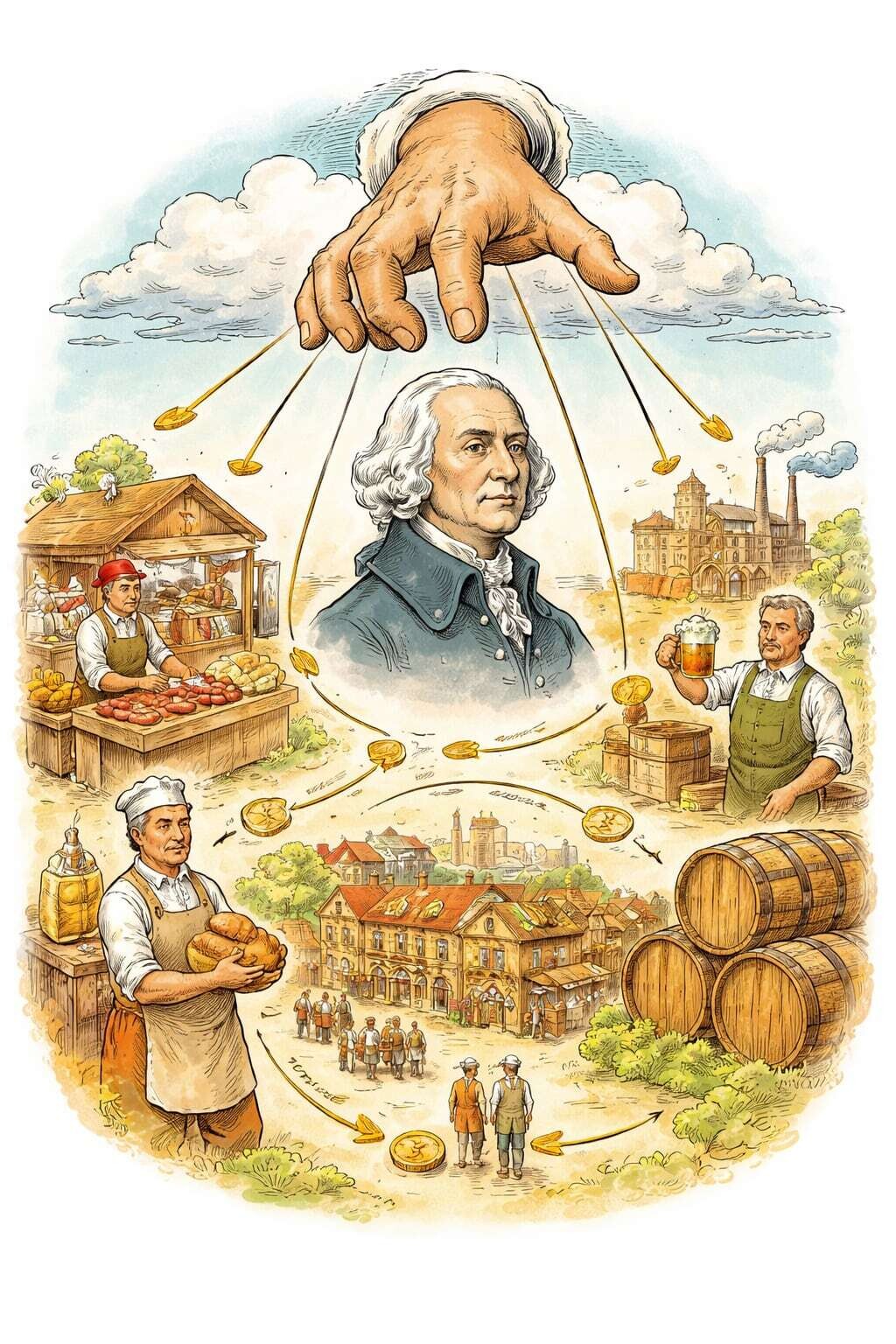
"It is not from the benevolence of the butcher, the brewer, or the baker that we expect our dinner, but from their regard to their own self-interest," Adam Smith decrees for his contemporaries and posterity.
The book is often reduced to a single idea: the famous "invisible hand" and "laissez-faire." However, Smith never proposed a market without rules or a naive defense of private interests. In one of his most cited observations, he warns that "people of the same trade seldom meet together, even for merriment and diversion, but the conversation ends in a conspiracy against the public, or in some contrivance to raise prices."
There is nothing new under the sun! This statement reveals a Smith very different from the caricatured, unconditional defender of capitalism. Each individual, by specializing, contributes to a much larger system that no one designed completely.
However, and here lies one of the richest and most current readings of his work, Smith did not blindly trust market actors. In his vision, the true enemy of prosperity was not commerce, but its manipulation for the benefit of a few. Another less-known but equally relevant aspect is his reflection on education. In a world marked by large corporations, concentrated markets, and debates about regulation, his warnings about collusion and privileges resonate strongly.
His central concern was not the market itself, but its corruption through privileges, monopolies, and collusion. For Smith, prosperity does not arise from state planning, but from the free interaction of individuals seeking to improve their own condition. He harshly criticized guilds, chartered companies, and any form of state capture by particular interests.
Smith recognized that the very division of labor that drives wealth can have negative effects on the individual. His project was more ambitious: to explain how a society could coordinate millions of individual decisions without central design, while at the same time warning of the risks inherent in that process. One of his fundamental contributions is the concept of spontaneous order.
In times of polarization between those who idealize the market and those who distrust it, his work offers a more nuanced perspective: trust the system, but never stop watching its actors.
Finally, when one sees the disaster of statist economies and the collapse of that crazy idea of forming the "new Soviet," "Cuban," or "Venezuelan" man, I imagine the old Adam with his great friend David Hume, looking on with astonishment at how the butcher, the baker, and the brewer became so stupid as to expect everything from the state.
The author is a member of the Libertad Foundation.
In his vision, education not only improves productivity but also strengthens social cohesion and political stability. This point is key to understanding the complexity of his thought. Likewise, his concern for the social effects of labor specialization anticipates contemporary discussions on automation and human capital.
Perhaps the greatest relevance of Smith lies in his balance. Smith does not advocate for an absent state, but for a limited one focused on essential functions: defense, justice, public works, and education. On the contrary, he was deeply skeptical of the behavior of merchants when they acted in groups. In his words, they become "as stupid and ignorant as it is possible for a human creature to be."
Faced with this risk, Smith proposes a surprisingly modern solution: the provision of accessible basic education for the population. He understood that economic freedom is a powerful source of progress, but it also requires an institutional framework to limit its excesses. This is not a completely state-run system, but a mixed scheme in which the state plays an important role in facilitating access.
The worker subjected to repetitive tasks loses the ability to fully develop his intellectual faculties. He recognized both the virtues of the market and its flaws.
After 250 years since its publication, "The Wealth of Nations" continues to offer valuable lessons. His liberalism is not dogmatic, but pragmatic.
In 1776, in a world of monarchies, privileges, and protected trade, Scottish philosopher Adam Smith publishes on March 9th in London his work "An Inquiry into the Nature and Causes of the Wealth of Nations." The division of labor—illustrated by his famous example of the pin factory—allows for an unprecedented expansion of productivity and the market.