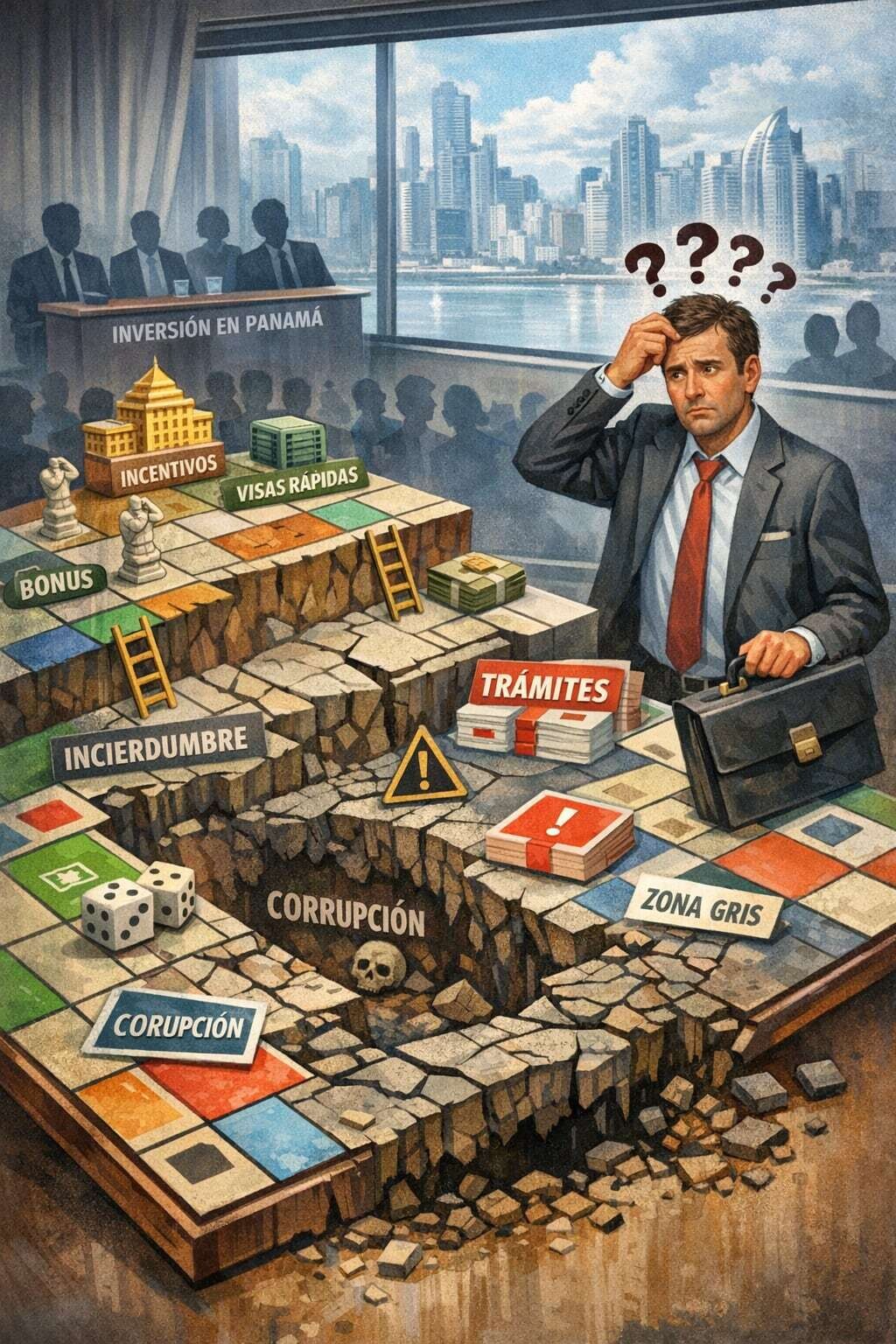
Panama is becoming more expensive—and smaller—for everyone. Think of it as a board game: who wants to play if the board is applied unevenly? Demand clear rules, public deadlines, and real consequences when someone breaks the pact. Open Pandora's box: transparency in public procurement, contracts, and the rules of the game—so it's known who decides what, when, and why—and sustain public pressure for things to be delivered on time, not when they've already lost meaning. Panama is already a bridge to the world. Until a woman from the audience asked for the floor and asked: “And what about trust?”. And for those of us who work to attract 'good' and patient capital—the one that bets on talent, green initiatives, and Panama's potential—life would finally become much less costly. The author is an economist and works connecting long-term capital with projects in Panama. Now it's time to be the bridge of trust in Latin America. And trust is not decreed: it is designed. How do I know the next government won't reverse everything?”. The room fell silent for a few seconds. But we all pay for it anyway. What can we do as a country? When the cost of operating goes up, the final price goes up. Distrust also creeps in through silences: projects that take years to approve out of fear of signing; short-term contracts to 'see if it works'; alliances that break because no one dares to tell the truth; young people who don't see themselves here in ten years. None of that appears in the financial statements. For Panama, redesigning it is a condition to stop selling our future for a song. When that environment exists, success stops feeling like a gamble. A country borrows like a family. And that cost doesn't stay 'up there': when the state finances itself expensively, it pays more interest, leaving less for schools, health, or infrastructure. The day we are known as the country where rules are understood and respected—for nationals and foreigners, for old and new surnames—there will be no need to go begging for investment. No need to be a statistic to understand the message: we little trust those who make decisions, and outside we are not seen as a particularly reliable country. If you sat with me in private meetings with family funds, companies, and long-term entrepreneurs, you would see another side of the story. It's not that the game is difficult; it's that people who want to play fair and seek tables where the rules are equal for all. Part of my job is to bring good and patient capital. The conversation always comes back to the same thing: if there is a stable path to enter, operate, and exit without depending on favors. Long-term capital seeks clarity and precision. It needs understandable and stable rules to commit money, talent, and time. It rewards the one who navigates uncertainty and punishes the one who needs clear rules to build long-term. On stage, they talked about fast visas, incentives, and benefits. It sounded easy. Recently, I was at a forum on investment in Panama. Nobody comes to have Panama sold to them in a PowerPoint; they come with their own numbers. Despite training in economics, data, and business—and experience in Europe and Taiwan—closing a certain budget to operate here has been more an exercise in exploration than planning: phones that don't answer, requirements that appear late, different criteria depending on who attends the window, and time wasted deciphering changing rules. If you give trust, they lend you cheaper; if they doubt, they charge you 'just in case'. There was the question that is rarely asked out loud. Distrust doesn't scare all investment away: it filters it, letting the worst pass. In 2025, the Ministry of Economy and Finance of Panama showed that Panama was paying about 3% extra on the base rate due to risk, above Chile (1.3%) and Peru (1.7%). That surcharge is spread throughout the economy: banks and companies finance themselves more expensively, and the corner business ends up raising prices. Additionally, that surcharge does not appear in the financial statements. In the 2024 Corruption Perceptions Index, Panama scores 33 out of 100 points, versus 78 for the Netherlands—on a scale where higher means lower perceived corruption. And the internal thermometer agrees: the 2023 Latinobarometer reports that only 16% of Panamanians express some or a lot of trust. Nobody comes to have Panama sold to them in a PowerPoint; they come with their own numbers. Recently, I was at a forum on investment in Panama. Despite training in economics, data, and business—and experience in Europe and Taiwan—closing a certain budget to operate here has been more an exercise in exploration than planning: phones that don't answer, requirements that appear late, different criteria depending on who attends the window, and time wasted deciphering changing rules. When no one can foresee times or requirements with precision, the business owner learns to budget for 'just in case': more days without opening, more paperwork, more immobilized inventory. And when a country feels this way, the serious investor—and also the local entrepreneur—does the logical thing: protects themselves or doesn't play. That is seen in the numbers. It sounded easy.