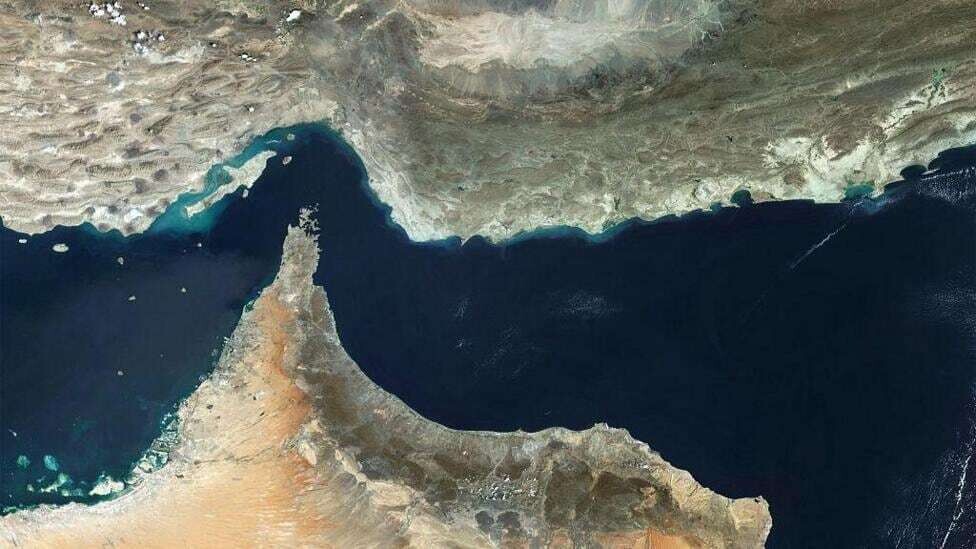
When a country cannot guarantee its energy supply, its clients start looking for alternatives. Not necessarily due to price. But for security. In this context, having energy pre-positioned is not an unnecessary expense. It only changes its form. That's why modern energy security cannot depend on a single point. It needs redundancy. This country can offer that. Not just as a logistics hub, but as a point of trust. This opens a clear opportunity. The country can become a space where energy not only transits but is also managed, positioned, and secured. For economies like Japan or South Korea, the cost of ensuring availability is small compared to the impact of uncertainty. For us, that same flow represents investment, economic activity, job creation, and a constant influx of capital. The country is small. It's a real limitation. This means that energy security is not a matter of months. It's about how we face it. In engineering, when a system receives a sudden load, it cannot always be eliminated, but it can be distributed over time. It can handle it. And what for large economies is a manageable cost, here represents a significant opportunity. Moreover, this is not a long-term project. With clear agreements between suppliers—particularly from the United States—logistics operators, and consumer countries, this system can begin to operate in a matter of weeks. There's no need to invent anything. It's just a matter of organizing what already exists. In an increasingly uncertain world, resilience is starting to be more valuable than efficiency. The global system does not necessarily need more routes. It needs better control points. Panama can be one of them. The author is a mechanical engineer. Highly developed economies like Japan and South Korea have large oil reserves, but their margin on natural gas—key for electricity generation—is much more limited. They cannot store it all. Costs rise, trade is disrupted, and uncertainty spreads quickly. Our country is not isolated from this reality. The question is not if the impact will arrive, but that it is already here. On that basis, there is an additional opportunity: to turn the country into a point of energy availability. Not to replace the current system, but to reinforce it. The country can become a place where energy—natural gas, oil, and derivatives—is strategically positioned, ready to be dispatched according to demand. There is also a vulnerability that is rarely discussed. The world is entering a stage of energy instability that should not be underestimated. Tensions in critical regions have exposed a structural weakness in the global system: it is efficient but fragile. It is a guarantee. And this does not require a massive scale to begin. An initial scheme with three or four tankers strategically positioned in the country can function as a floating buffer capable of responding immediately to a disruption. It does not replace the global system. It stabilizes it. And over time, it can evolve into a permanent model. There is also a reality that cannot be ignored. Even in stability scenarios, energy routes will remain sensitive. By reducing the peak, the system stabilizes. The same principle applies to global logistics. Today, energy chains operate with high efficiency but little flexibility. Before the ship sails, there is a process of allocation, coordination, and reloading at the origin ports that can take between ten and twenty days. That time is structural. It is not eliminated by operational efficiency. If the supply is already pre-positioned at this strategic point, that time disappears. The transit to Asia still exists—typically on the order of three weeks—but the difference is fundamental: one no longer waits for availability; one operates on existing inventory. It is not the same to start a process as it is to execute a response. This change reduces pressure, reduces costs, and, above all, reduces uncertainty. Because the impact is not just logistical. It is financial. It is psychological. Markets react to fear. It is played out in weeks. That limitation is not minor. If economies like Japan or South Korea face a restriction in natural gas, the impact does not stay in Asia. It moves to the world. Production is affected, supply chains are strained, and financial markets react. The security of natural gas in these countries is, in practice, a factor of stability for the global economy. This is where a critical point comes in. Today, when a country needs natural gas, maritime transport alone is not enough. The routes are long, the times are rigid, and the response points are limited. When a disruption occurs, the system has little capacity for immediate reaction. Panama already plays an essential role by guaranteeing the safe transit of vessels between oceans. When a disruption occurs, the effects are immediate. Uncertainty stops investment, delays decisions, and alters entire commercial chains. Uncertainty does not disappear.