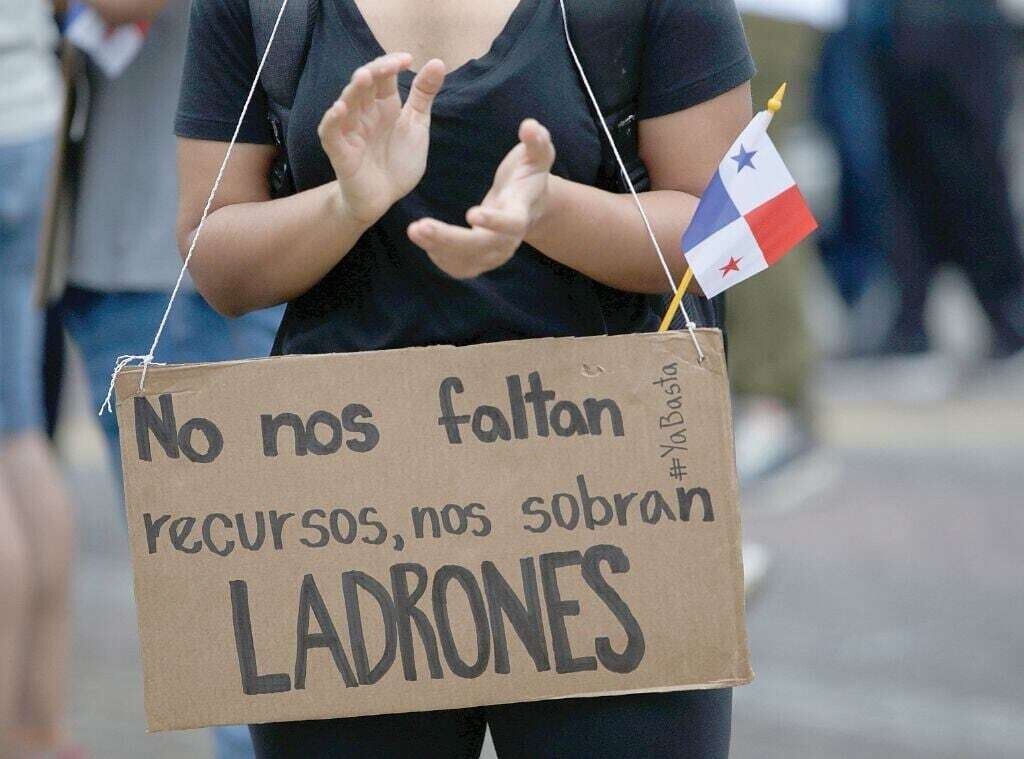
Narrating democracy from these spaces implies creating new ideas, transforming concepts, and opening new paths. Since its creation in 2025, they have carried out around 18 activities, including public debates, educational citizen encounters, Latin American cinema and theater nights with an environmental theme, and public civic-environmental acts. The initiative of public workshops teaches people citizen participation processes, facilitating direct exchange with decision-makers and specialists, providing the tools for influence on national politics, assures the collective. These initiatives foster interaction between panelists and citizens through dialogue to reach a common understanding. Understanding that the only way to change course is by occupying the space that corresponds to us, I participated during the month of February in the program Think Panama / Narrate Democracy, a project managed by the British Embassy in Panama and the media outlet Concolón, led by journalist Sol Lauría. If we use these spaces to tell new stories, our environment begins to transform. I come out of this experience convinced that citizen participation is not a privilege, but a necessity, and consequently, a right. Its central idea is clear: democratic societies can only be sustained if citizens dialogue freely, argue, and seek rational consensus. This condition responds to governance problems, the weakness of political culture, and freedom of the press, which faces greater threats every day. Participating in dialogue is to exercise democracy while exercising our right to free expression. The author is an internationalist. The absence of these spaces makes it easier for demagogic leaderships to appropriate the state structure, with the risk that the country will fall into corruption or drift towards authoritarianism. After the 1980s, it was thought that authoritarianism in Latin America was behind us, but today it resurges with force. With an intergenerational vision, they are the only initiative that created open debates on Law 462, the Social Security Fund Reform, and the Río Indio dam. It is our way of claiming sovereignty before the political sterility. Current freedoms are increasingly deteriorated, not so much by authoritarian regimes or instability, but by political apathy, a symptom of false electoral promises and the disinformation generated by the lack of civic participation. The absence of civic spaces, at the same time, the recent weakening of trade unions, takes its toll on democratic quality. In the case of Panama, according to The Economist, we are a flawed or imperfect democracy. Civic space is not asked for: it is taken. It is an initiative created and designed by approximately 20 citizens that has impacted more than 1,500 citizens. For a month, in addition to fostering ideas for writing an opinion column, we reflected on the need for spaces to 'tell stories,' as we say in Panama, or rather, to listen and narrate democracy from the collective imaginary. 'For those of us who have no beliefs, democracy is our religion.' —Paul Auster Inhabiting the spaces that are provided for dialogue is to recover our place in politics. Currently, only 6.6% of the world's population enjoys a 'full democracy,' a significant regression compared to 2014, when it reached 12.5%, according to The Economist's Intelligence Unit (EIU). With the intention of slowing these effects, citizen participation spaces have the virtue of creating an ecosystem for dialogue that goes much further than an Instagram post or a tweet. Citizen participation is not an act of goodwill; it is an exercise that occurs continuously. It is going out into the street to build a collective imaginary, a common language with which we dream of an alternate reality. For example, countries that offer spaces for public debate have referents such as Speakers' Corner (Speakers' Corner), a world symbol of freedom of expression located in Hyde Park, London, which has functioned as a political platform since 1866. However, in the face of this void, cracks of resistance emerge: efforts that, although not everyone knows them, have begun to make themselves known in recent months. Perhaps some of them you know: the collective 'Five Cats Panama' that is born from the iconic phrase once used by President Jose Raul Mulino about the reopening of Cobre Panamá. Here, the dialogue that arises from the streets continues to influence what happens at the polls. Inhabiting public spaces for dialogue is precisely the axis of the thought of the German philosopher Jürgen Habermas. We have always been, but that does not mean that it cannot change. Decades later, this corner would give rise to the event 'Women's Sunday,' which paved the way for women's suffrage in 1908.