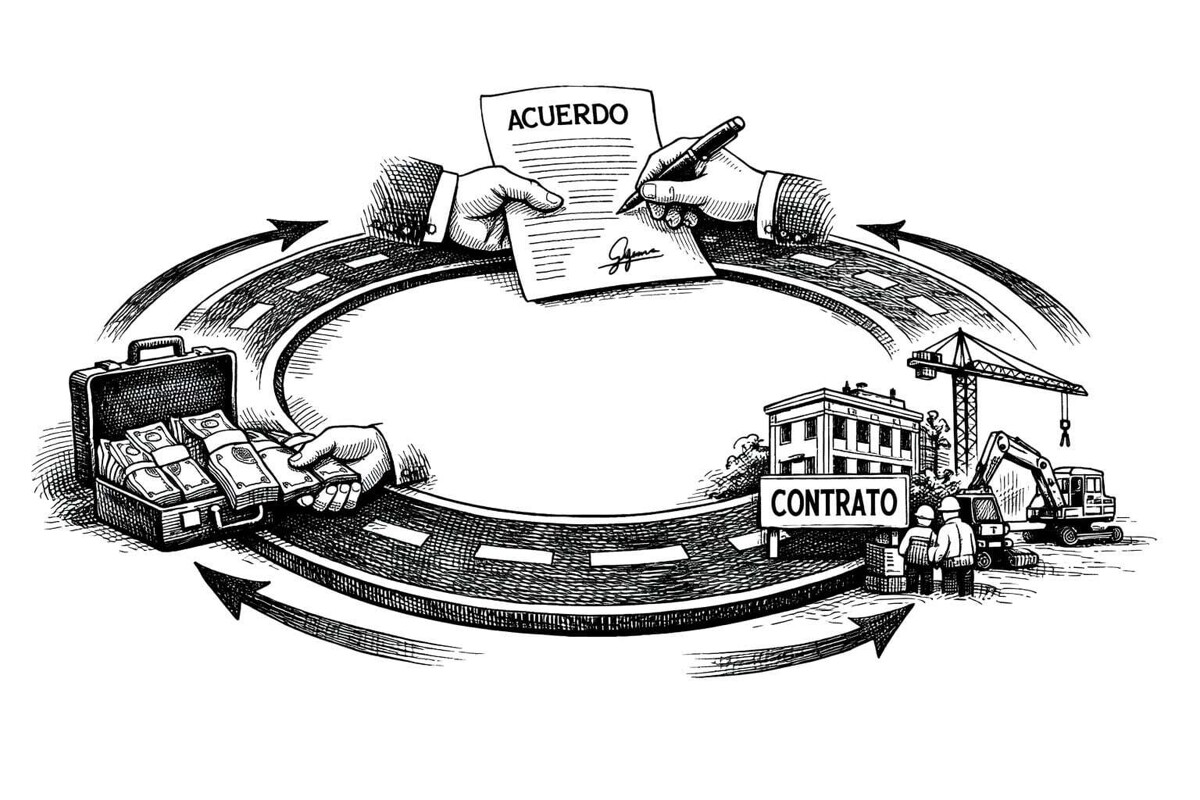
To close this gap, Panama should incorporate into Law 22 of 2006 and the Penal Code an automatic and permanent ban on contracting for companies convicted of corruption, for those whose executives have been convicted, and for those that have admitted responsibility in effective cooperation agreements. It is also essential to create a public registry of sanctioned companies that allows for institutional interoperability, citizen control, and traceability of sanctions. This legal loophole has allowed societies whose executives have admitted bribes or fraudulent practices to continue to be eligible to contract with the State. Although in recent years legislative initiatives have been presented aimed at introducing permanent or automatic disqualifications, these have become stalled or archived in the National Assembly, without sustained public debate or significant social pressure for their approval. Disqualification from public contracting due to corruption remains one of Panama's major institutional debts. While in numerous legal systems a criminal conviction for crimes against the public administration implies immediate exclusion, and in many cases permanent, from the contracting system, in Panama the current regulations only contemplate a temporary and limited disqualification. Although Law 22 of 2006, in its article 24.8, establishes a "legal incapacity to contract" of up to five years for natural or legal persons convicted in the previous five years for crimes against the public administration, this measure is not automatic or permanent, nor does it cover older convictions or all effective cooperation agreements. Colombia, for its part, introduced in Law 1474 of 2011 the disqualification to contract with the State for companies whose legal representatives have been convicted of crimes against the public administration. Spain incorporated this model through Law 9/2017 on Public Sector Contracts, whose articles 71 and 72 establish the prohibition of contracting for companies convicted of corruption crimes. The absence of an automatic and permanent disqualification weakens public trust, encourages recidivism, generates unfair competition against compliant companies, and puts the country at a disadvantage compared to trading partners that demand higher levels of integrity. In systems such as the European, American, or Colombian, it would be unthinkable for companies whose executives have been convicted of corruption to continue contracting with the State without immediate and lasting consequences. The Constitutional Court has established proportionality criteria and protection of the public interest, among others, in Sentence C-630 of 2012. From the comparative analysis, clear patterns emerge: disqualification following a criminal conviction for corruption is the rule in the most robust systems; liability extends to the legal person and is not limited to the individual executive; rehabilitation mechanisms exist, but they are subject to strict standards; and transparency is reinforced through publicity and verification systems. From a philosophical-legal perspective, these models respond to a logic of institutional reciprocity: as John Rawls argued, the legitimacy of public power depends on the burdens and benefits of the legal system being distributed fairly and reasonably among those who participate in it. This exclusion is directly linked to the criminal sentence and may extend to companies whose executives are involved in such conduct. The Directive itself introduces the self-cleaning mechanism (article 57.6), which allows the company to regain its eligibility only if it demonstrates the repair of the damage caused, effective cooperation with the authorities, the adoption of adequate compliance programs, and the replacement of the responsible executives. Administrative sanctions depend on internal procedures that, in practice, do not always translate into an effective exclusion from the public market. Public contracting is, by definition, an area especially vulnerable to corruption due to the volume of resources involved and the asymmetry of information between the State and economic operators. Comparative experience shows that the most effective systems incorporate automatic exclusion mechanisms for companies convicted of certain crimes, as well as strict conditional rehabilitation procedures (self-cleaning). Comparative law shows that disqualification from contracting due to corruption is not an exceptional measure, but a minimum standard to protect the integrity of public contracting. Adopting a model aligned with international standards would close the door to corporate impunity and strengthen public governance. The author is a lawyer, researcher, and Doctor of Law. In the European Union, Directive 2014/24/UE establishes the mandatory exclusion of economic operators convicted of corruption, fraud, money laundering, or participation in criminal organizations (article 57.1). In the United States, the federal exclusion regime (debarment and suspension), regulated in the Federal Acquisition Regulation (FAR), Subpart 9.4, allows for the removal of contractors for reasons such as convictions or conduct related to fraud and bribery. It is almost unbelievable, or directly offensive to citizen intelligence, that companies whose executives have confessed or been convicted of acts of corruption continue to participate and win state bids. The jurisprudence of the Supreme Court has confirmed that this prohibition constitutes a necessary consequence of the criminal conviction, without the need for an additional administrative procedure to activate it in the cases provided for. This approach responds to a conception of public law in which integrity is not an accessory value, but a structural condition of state action. It is an administrative mechanism aimed at protecting the public interest and the integrity of the contracting system, whose effects are reflected in the exclusion registers published in the System for Award Management. In Latin America, Brazil combines Law 12.846/2013 (Anti-Corruption Law), which provides for administrative sanctions and the prohibition of contracting with the public administration, with Complementary Law 135/2010 (Clean Slate Law), which extends disqualifications to political actors linked to corruption. Panama, lacking a robust regime, is exposed to systemic risks and erodes citizen trust. Panama is lagging behind these standards. Similarly, a self-cleaning mechanism could be incorporated that would allow rehabilitation only when the company demonstrates the recognition of illicit facts, restitution of the damage, full cooperation with the authorities, implementation of certified compliance programs, and replacement of the involved executives. Finally, it is necessary to strengthen judicial and administrative control, granting the Comptroller's Office and administrative courts clear powers to apply and review disqualifications, as well as to harmonize Panamanian legislation with the United Nations Convention against Corruption, the Inter-American Convention against Corruption, and the OECD recommendations on public integrity.