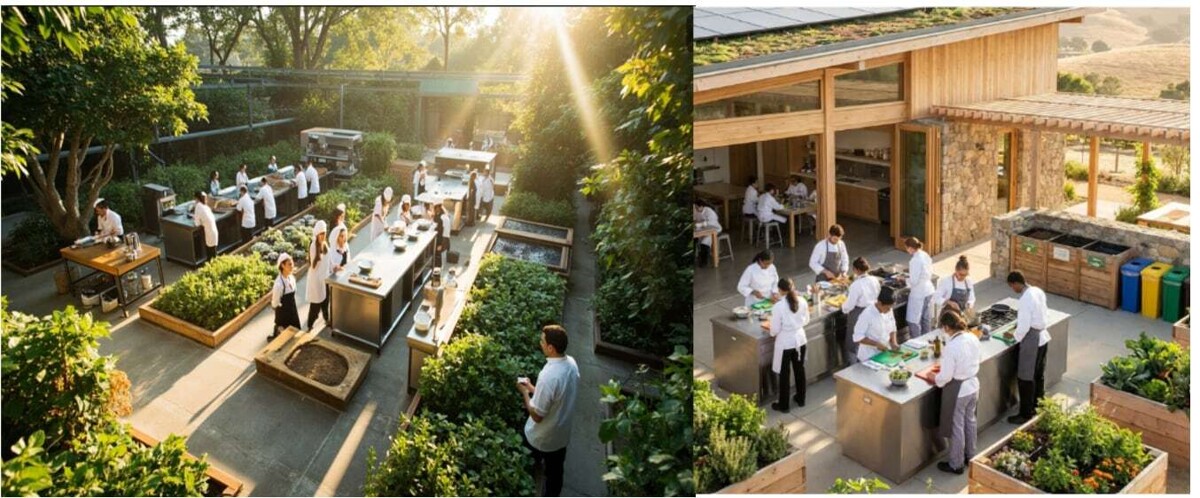
This is a space where students can learn in direct contact with nature, understand the origin of food, participate in cultivation processes, and develop sustainable practices. Students spend much of their lives in a classroom, trying to imagine how the world works beyond that space. There are careers that have the advantage of having a direct connection with nature, allowing them to interact in real-world contexts. The truth is that this profession involves much more and entails a high responsibility towards the environment and climate change. The production of food generates approximately 30% of global greenhouse gas emissions, and within these, methane plays a significant role, being one of the main contributors to current global warming. Concepts such as sustainability and circular economy are frequently mentioned, but are often not recognized as practices that can be integrated into daily life in the kitchen, with the use of waste, reduction of waste, and respect for natural cycles. Currently, from the Gastronomy degree at the University of Panama, they seek to instill in students a more conscious vision, promoting creativity, the use of resources, and the understanding that every action has an environmental consequence. In this context, the 'Green Classroom' emerges as a pedagogical alternative that allows transforming traditional teaching. However, in other areas such as gastronomy, it is often thought that its practice is limited exclusively to the kitchen. From the classrooms, it is necessary to sow seeds of awareness that can grow and multiply in each student, transcending beyond the academic space. In summary, educating is not only about transmitting knowledge, but about forming individuals capable of transforming their environment, turning their education into life itself. The author is an architect and a second-year student at the Faculty of Gastronomy of the University of Panama. This fact shows that every decision regarding food, from its origin to its consumption, has a direct impact on the planet. In this sense, the gastronomer must not only focus on the preparation of dishes for enjoyment, but also understand and act on what happens before and after each process. It is common to visualize teaching in a four-walled space, a little disconnected from its environment and with a dynamic that can become monotonous. This type of environment not only complements theory, but also strengthens experiential learning, generating a deep connection with the environment and fostering greater environmental sensitivity. Green classrooms, implemented in different international contexts, have shown that learning outside the traditional classroom not only improves understanding, but also awakens interest, fosters empathy, and the commitment of students to their reality. We cannot continue to train ourselves in a bubble, ignoring that the environment is a fundamental part of our existence.